A failed call to Spain usually doesn't happen because someone forgot the country code. It happens because the number was stored in the wrong format, the wrong dialing prefix was used on the wrong device, or the office phone system treats international calls differently than a mobile app.
That's the part most basic guides miss. If you're trying to reach a customer, confirm a vendor meeting, support a remote team, or book appointment slots with a Spanish office, the issue isn't memorizing 34. The issue is building a calling process that works the same way across smartphones, desk phones, and cloud systems.
Connecting with Spain Beyond the Country Code
A common business scenario goes like this. Someone has a Madrid callback on the calendar, clicks the contact, and the call fails. Then they try again from a mobile, then from a desk phone, then through a softphone, and each attempt behaves differently.
That inconsistency is what makes how to call Spain more of an operations problem than a trivia question. The dialing rule itself is straightforward. The hard part is getting clean number formatting, choosing the right calling method, and making sure the team uses the same standard every time.
Practical rule: If your team stores international contacts in one format and dials them from multiple systems, you'll prevent more failed calls than you will by handing people a cheat sheet.
For businesses, the goal is reliability first. Cost comes next, but not far behind. A missed follow-up with a prospect in Barcelona or a delayed call to book appointment confirmations with a clinic or service provider in Spain creates friction that simple country-code guides don't address.
The most effective approach is to standardize how numbers are stored, decide which devices should handle outbound international calls, and make scheduling part of the process instead of treating every Spain call like a cold dial.
The Core Dialing Pattern for Calling Spain
The dialing pattern itself is simple. The mistakes usually come from using the wrong prefix, dropping part of the local number, or assuming Spanish landlines work like numbers in countries that still use a separate area code.
Spain's country code is 34, and Spanish numbers are dialed as a full national number. For a U.S. caller on a traditional line, the standard pattern is 011 + 34 + the full Spanish number. Spain uses a closed numbering plan, so the opening digits for cities such as 91 for Madrid, 93 for Barcelona, 96 for Valencia, and 95 for Sevilla stay in the number. You do not remove them before dialing.
That point causes a lot of failed business calls.
How the pattern works
Use this order:
Exit code
From the U.S., enter 011 if your system requires a standard international prefix.Country code
Spain is 34.Full Spanish number
Dial the complete Spanish number as assigned.
A Madrid landline such as 915 555 555 keeps the 91. A Spanish mobile also keeps its full number. The practical rule is straightforward. If the number was given to you as a complete Spanish number, dial the complete Spanish number after 34.
Dialing examples for calling a Madrid number (915 555 555)
| Calling From | Exit Code | Full Dialing String |
|---|---|---|
| United States | 011 | 011 34 915555555 |
| Mobile using international format | + | +34 915555555 |
Dial the full Spanish number exactly as assigned. Do not strip off the opening geographic digits from a landline.
For businesses, the bigger issue is consistency across systems. CRM records, mobile address books, and call queues should all store Spanish contacts in international format so staff are not rewriting numbers by hand. If your team handles volume outreach or support, a cloud-based contact center platform makes that formatting easier to control across users and devices.
Dialing Spain from Your Mobile, Landline, or Business VoIP
A sales rep calls a client in Barcelona from a mobile and gets through. Ten minutes later, the same number fails from the office desk phone. In most cases, the number is fine. The problem is the device and how that system handles international dialing.
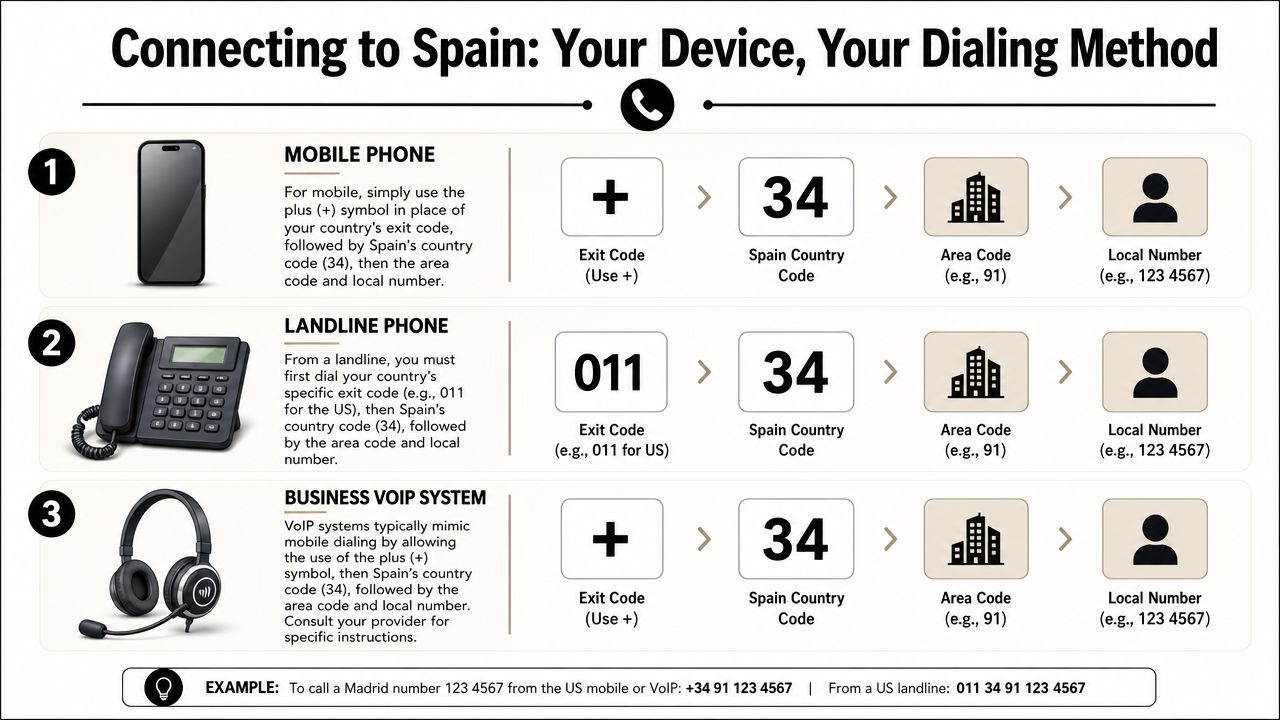
Mobile phones
Mobile phones are usually the simplest option for calling Spain because they accept the + format directly. If the contact is saved correctly, dial +34 and then the full Spanish number.
That approach avoids a common mobile mistake. Staff manually enter a U.S. exit code out of habit, then run into issues while roaming, switching carriers, or using a mobile dialer that already expects international format.
For business use, store Spanish contacts in full international format in the company directory, not as locally styled numbers copied from email signatures or websites.
Landlines and office desk phones
Desk phones and traditional landlines are less forgiving. Many still require the international access code configured for that carrier or PBX. In the U.S., that is often 011 before 34 and the full Spanish number.
Businesses lose time when an employee knows the Spanish number is correct but forgets that the desk phone follows different dialing rules than their mobile. On older office systems, international calling may also be blocked by class-of-service settings, which makes the failure look like a bad number when it is really a permissions issue.
Business VoIP platforms
Business VoIP is usually the cleanest setup for repeated calls to Spain. It lets IT or operations teams standardize contact records, caller ID, routing, and call logs across desktop apps, mobile apps, and desk phones.
The trade-off is configuration. A VoIP platform only saves time if admins set dialing policies correctly, normalize numbers to +34 format, and test outbound routes for Spain in advance. If they do, agents stop guessing which prefix to use on which device.
For teams making regular international calls, a cloud-based contact center platform for managing outbound and support workflows also gives supervisors one place to control dialing behavior and review failed call patterns.
Smart Strategies to Reduce International Calling Costs
A finance manager approves a low per-minute international plan, then the sales team keeps missing contacts in Spain because calls show up from personal mobiles, audio quality varies by device, and no one can see which attempts failed. The bill looks controlled. The process is not.

For business calling, cost sits in three places: carrier charges, staff time, and failed outreach. A cheap route loses its value fast if reps redial from different devices, leave no call record, or trigger callbacks to the wrong number.
The practical question is simpler. Which setup reaches Spain reliably, keeps costs predictable, and fits the way your team already works?
Compare the common options by business use, not headline price
- Direct carrier dialing: Fine for occasional one-off calls. It becomes expensive and hard to control once multiple employees call Spain regularly from separate mobile or desk phone plans.
- Consumer messaging apps: Useful if both parties already use the same app and the conversation is informal. They create problems for audited call logs, shared ownership of contacts, and consistent business caller identity.
- Business VoIP: Usually the best fit for repeated international calling because billing, call history, caller ID, and routing rules sit in one system.
I usually advise clients to stop comparing only per-minute rates. Compare the full workflow. If a rep can place the call from the CRM, keep the business number visible, log the outcome automatically, and hand follow-up to another teammate, the lower admin overhead often matters as much as the call charge itself.
Business VoIP also gives teams more control over Spain-specific issues that basic calling guides skip. Admins can set outbound policies by user or department, choose whether calls go through desktop apps or desk phones, and spot failed call patterns before they turn into a service problem. If you want to estimate the difference between legacy phone costs and internet-based calling, a VoIP cost savings calculator for business phone systems gives you a practical starting point.
One option in this category is Cloud Vision Technologies LLC, which offers hosted VoIP, contact center tools, and AI voice workflows that businesses can use for international calling and appointment handling.
Calling Spain for Business Best Practices
Connecting the call is only the first step. The second is making sure the person in Spain wants to take it when it arrives.

Many teams create their own friction by treating Spain like a domestic extension of their U.S. workday. That usually leads to voicemail, rushed conversations, or low response rates to callbacks.
Better calling habits
- Check local business timing: Don't assume your normal outbound block fits the Spanish workday.
- Avoid lunch-hour outreach: Many businesses in Spain still slow down in the middle of the day.
- Schedule important calls: For anything tied to sales, account management, intake, or renewals, it's better to book appointment time than to improvise.
A scheduling-first approach is especially useful for healthcare, legal, real estate, and service businesses. If your team often needs to confirm meetings, intake calls, or consultation slots, an AI receptionist can handle inbound capture and help book appointment requests before a live rep joins the conversation.
The professionalism test
Ask a simple question. If a prospect or partner in Spain misses your call, what happens next?
If the answer is “someone remembers to try again later,” the process is fragile. If the answer is “the system logs the attempt, routes the callback correctly, and offers a way to schedule the next conversation,” the process is ready for real business use.
Important calls to Spain shouldn't depend on memory. They should depend on workflow.
Why Your Call to Spain Might Be Failing
A failed call to Spain usually comes down to formatting, permissions, or PBX behavior. In business environments, I see one problem more than any other: the number looks correct to a person, but the phone system reads it differently.
That happens a lot when teams save Spanish numbers in mixed formats across phones, CRMs, and desktop dialers. One user stores a contact with spaces. Another includes brackets or a trunk prefix from a local format. A mobile app may still place the call, while a desk phone or VoIP platform rejects it. The result is inconsistency, which is harder to diagnose than a simple dialing mistake.
Quick troubleshooting checklist
- Wrong international prefix: U.S. landlines usually need 011 before the country code. Mobile devices and VoIP apps usually work better with the + format.
- Bad contact formatting: Parentheses, spaces, punctuation, or copied local formatting can break dialing on some carriers and business phone systems.
- International calling disabled: Many mobile plans, SIP trunks, and office phone systems block international outbound calling until an admin enables it.
- PBX routing rules: Some office systems require an outbound access digit or a specific international dial pattern before the call can leave the system.
- Number type mismatch: If your platform applies different routing or billing rules to mobiles and landlines, a misclassified destination can cause failed calls or unexpected charges.
The clean format to use
Store Spanish contacts in full international format, such as +34915555555. That gives your mobile phones, softphones, CRM dialers, and call routing tools one standard to work from.
For businesses, this is less about dialing etiquette and more about operational control. A single formatting rule reduces failed calls, makes click-to-dial more reliable, and keeps callback records clean across teams.
If calls to Spain still fail after you standardize number formatting, check the outbound path itself. Review carrier permissions, PBX dial plans, and any international restrictions on the user, site, or trunk. Those are common failure points in older phone setups and poorly configured VoIP deployments.
Cloud Vision Technologies LLC](https://www.cvtconnects.com) is one provider to review for hosted VoIP, AI voice handling, and contact center workflows if your team needs a more consistent way to call Spain, manage international outbound dialing, and handle appointment-related call flows without manual workarounds.