The day usually starts the same way. A customer calls while you're with another customer. The call rolls to voicemail. An email comes in asking about pricing. A web form asks to book an appointment. Someone on your team texts back from a personal phone because it's faster, and now the conversation lives in three places and nowhere useful.
That mess feels normal in a lot of small businesses. It's common in clinics, dental practices, law offices, home services companies, and growing sales teams. But it's expensive. Missed calls turn into missed appointments. Slow replies make prospects keep shopping. Staff spend too much time repeating the same answers and chasing scheduling details that should've been handled automatically.
Digital customer engagement fixes that when it's done correctly. Not by adding random channels, but by connecting the ones you already need so customers can move from question to answer to booking appointment without friction. A person might start in chat, move to a phone call, get routed to an AI voice agent, and receive an SMS confirmation without repeating their story once.
That's the shift. You stop treating phone, chat, email, and SMS as separate tools. You start treating them as one operating system for customer relationships.
Introduction From Chaos to Connection
A small business owner doesn't usually say, “I need a digital customer engagement strategy.” They say something more immediate.
“My receptionist can't keep up.”
“We miss calls after hours.”
“Too much time goes into booking appointments.”
“Customers ask the same questions over and over.”
Those are engagement problems, even if they don't sound technical. The root issue is fragmented communication. Your phone system lives in one place, your inbox in another, your website form somewhere else, and your scheduling process depends on whoever happens to be available.
Where the breakdown usually happens
Most communication breakdowns happen in a few predictable spots:
- Missed inbound calls: A prospect calls during lunch, after hours, or while staff are busy.
- Manual scheduling: Staff go back and forth to book an appointment, reschedule, or confirm availability.
- No shared context: One employee answers the phone without seeing the web inquiry or prior text thread.
- Slow follow-up: A customer asks a simple question, but the answer gets delayed because it depends on a person.
The result isn't just frustration. It's leakage. Leads leak out. Existing customers lose confidence. Staff spend their day reacting instead of moving people toward a next step.
Practical rule: If a customer has to repeat the same information across channels, your system is organized around your tools, not around the customer.
That's why modern digital customer engagement matters for small and midsize businesses. It brings order to the front end of the business. It gives customers one coherent experience, even when several systems are working behind the scenes. It also makes one high-value workflow much easier to control: booking appointment requests from first contact through confirmation and follow-up.
What Is Digital Customer Engagement Really
Digital customer engagement is often described as “interacting with customers across digital channels.” That definition isn't wrong. It's just incomplete.
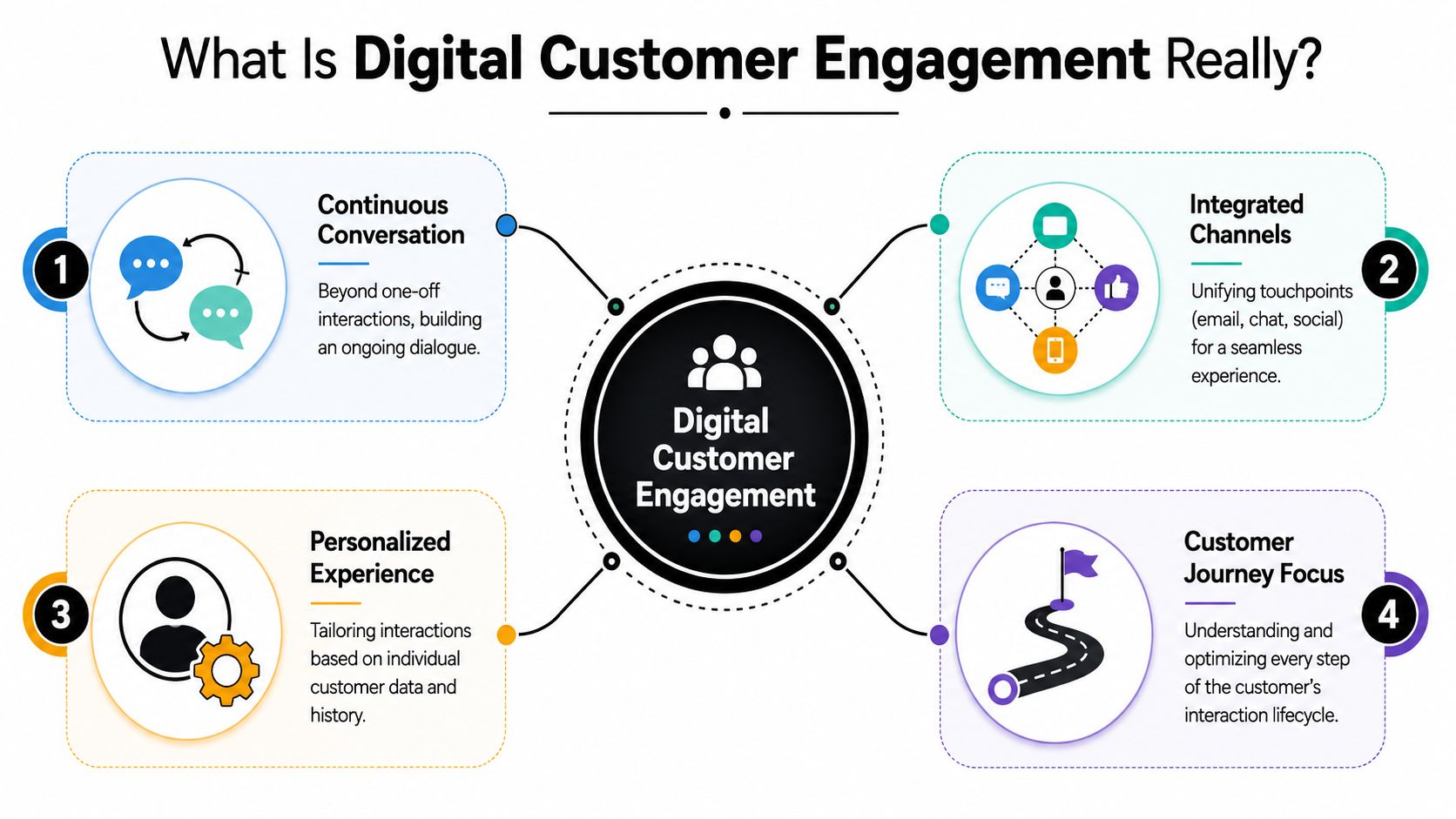
The useful definition is this: digital customer engagement is a continuous conversation across channels, with shared context and a clear business outcome. The outcome might be resolving a question, collecting intake details, or booking an appointment. The key is that the customer shouldn't feel like they're starting over every time they switch channels.
One conversation, not five disconnected ones
A clunky business runs customer communication like a stack of sticky notes. The website chat is one note. The phone call is another. The email reply is a third. Nobody sees the whole picture, so the customer repeats everything.
A good engagement system works more like a shared case file. Every touchpoint adds to the same record. If someone asks a question in chat, then calls, then confirms by SMS, the system carries the context forward.
That continuity matters because the strongest digital engagement setups are built as event-driven, omnichannel systems that unify voice, chat, email, social, and app interactions into one customer record, supporting real-time support, personalization, and predictive analytics, as explained in Teneo's guide to digital customer engagement.
A practical example with appointment booking
Here's what this looks like in the real world:
- A customer visits your website and asks in chat whether you have openings this week.
- The system captures the inquiry and basic details.
- The customer decides to call instead of typing.
- An AI voice agent answers, already aware of the question asked online.
- The agent offers available times and completes the booking appointment flow.
- The customer receives an SMS confirmation and a follow-up email.
That doesn't feel high tech to the customer. It feels easy. That's the point.
What digital engagement is not
A lot of businesses make the same mistake. They add more channels and assume they've modernized.
They haven't if these problems still exist:
- Separate inboxes: Teams monitor different channels with no shared visibility.
- No routing logic: Every inquiry lands on the same person, regardless of urgency or intent.
- No automation: Staff still handle repetitive FAQs, confirmations, and scheduling manually.
- No measurement: Management knows messages are going out but can't connect activity to revenue, retention, or booked appointments.
More channels can create more chaos if you don't unify them. The practical question isn't “Should we offer chat, SMS, and voice?” It's “Can a customer move between them without friction, and can we prove that the system helps us win and keep business?”
Why Engagement Drives Growth Not Just Satisfaction
Customer satisfaction matters. It just isn't enough on its own.
A business grows when communication helps people take the next step. In many small businesses, that next step is simple and valuable: answer the question, remove hesitation, and book the appointment before the customer drifts away.
The revenue case
This is why digital customer engagement deserves budget attention, not just operational attention. Investing in digital customer engagement has the potential to increase business revenue by up to 90%, according to Twilio's State of Customer Engagement.
That number gets attention, but the mechanism matters more than the headline. Revenue doesn't rise because a company installed new software. It rises because the business gets better at responding, guiding, converting, and retaining.
Where growth actually comes from
In practice, engaged businesses tend to improve in a few concrete ways:
- They capture more demand: Fewer calls go unanswered, especially after hours or during busy periods.
- They shorten the path to action: Customers don't wait for a callback just to schedule a consultation or service visit.
- They protect staff time: Teams stop spending the day on repetitive questions and routine booking tasks.
- They reduce drop-off: People are less likely to abandon the process when context follows them from channel to channel.
A missed call is rarely just a missed call. In many businesses, it's a missed estimate, consultation, intake, or appointment slot that won't come back.
That's why I treat engagement as a pipeline issue, not just a support issue. If your communications stack makes it hard for customers to reach you, trust you, or schedule with you, it's limiting growth.
Satisfaction is the byproduct
Customers usually don't praise a business for “excellent omnichannel orchestration.” They say, “They got back to me right away,” or “Booking was easy,” or “I didn't have to explain everything twice.”
Those moments build trust. Trust improves retention. Retention supports revenue. So yes, satisfaction matters. But the stronger argument for digital customer engagement is that it turns customer contact into a measurable business asset instead of a daily firefight.
Mapping Your Customer Engagement Channels and Journeys
Most businesses think in channels. Customers think in outcomes.
A person doesn't wake up wanting to use your phone system, your chatbot, or your email workflow. They want an answer, a resolution, or a booking appointment. The channel is just the path they take.
The journey matters more than the channel list
A modern engagement journey connects channels so each one picks up where the last one stopped. That's what people mean when they talk about omnichannel. Not “we have five ways to contact us,” but “we can continue the same interaction across five ways to contact us.”
If you're comparing systems, this is the practical benchmark I'd use: can the platform carry context from inquiry to resolution, including scheduling? That's the difference between a toolset and an actual operating model. For teams evaluating a more unified support environment, a cloud contact center approach is often where that orchestration starts to become manageable.
A healthcare clinic example
Take a clinic trying to reduce front-desk overload.
A patient searches online, lands on the website, and asks through web chat whether same-week visits are available. The site captures the question and basic details. A few minutes later, the patient calls because they'd rather speak than type. The AI voice agent answers, recognizes the reason for contact, checks routing or scheduling rules, and offers to book the appointment.
After the booking appointment is completed, the system sends an SMS confirmation. If the patient needs preparation instructions, email handles that well. If something changes, staff can see the full interaction history before speaking with the patient.
That flow feels simple from the outside. Under the hood, it only works when the system is designed around shared events and customer state.
What an event-driven setup changes
The technical side matters because it affects the customer experience directly. As noted in the earlier section, digital customer engagement is strongest when it unifies interactions into one record and supports real-time action. In practice, that gives you capabilities like these:
| Channel | Best use | What breaks without integration |
|---|---|---|
| Voice | Urgent, complex, high-intent conversations | Staff answer blind with no prior context |
| AI voice agent | After-hours coverage, FAQs, booking appointments | Customers hit dead ends or generic menus |
| Web chat | Quick questions and intake capture | Conversations vanish when the customer calls |
| SMS | Confirmations, reminders, follow-ups | Messages become isolated and untracked |
| Detailed instructions and documentation | Slow handoffs create duplicate work |
Common journey mistakes
The biggest failures usually aren't technical bugs. They're design mistakes.
- Channel sprawl: Adding chat, SMS, and voice without a shared customer record.
- Broken handoffs: The AI handles the start, but live staff can't see what happened.
- No booking logic: A system can answer questions but still can't complete an appointment workflow.
- No follow-through: Confirmation and reminder messages aren't tied to the original interaction.
If your channels don't share memory, customers do the integration work for you. They repeat the issue, restate their preferences, and re-enter scheduling details.
That's exactly what a modern engagement architecture should prevent.
The Right Tech Stack for Seamless Engagement
Once the journey is clear, the next question is practical. What technology do you need?
For most SMBs, professional practices, and service teams, the stack doesn't need to be huge. It needs to be connected. I'd break it into three core layers: a cloud phone system, an AI voice layer, and a contact center or unified interaction layer.
Start with the calling foundation
The first layer is a Hosted VoIP or Cloud PBX. This replaces the old phone system and gives you the basics you should already have: call routing, auto-attendants, call recording, voicemail handling, and access from any device.
That matters because many engagement problems still start at the phone level. If calls can't be routed intelligently, tracked cleanly, or answered from anywhere, the rest of the stack won't save you. Voice is still one of the highest-intent channels in most local and service-based businesses.
Add an AI voice agent where work repeats
The second layer is the AI voice agent. Here, a lot of SMBs either overcomplicate things or underestimate the opportunity.
An AI voice agent shouldn't try to replace every human conversation. It should handle repetitive, structured interactions that don't need a person every time. That usually includes:
- Answering common questions: Hours, location, services, basic intake requirements.
- Capturing intent: Figuring out whether the caller needs support, sales, billing, or scheduling.
- Booking appointment requests: Offering time slots, collecting details, and confirming the next step.
- Escalating gracefully: Handing the call to a live person when the issue is sensitive, high-value, or complex.
This shift isn't niche. By 2026, artificial intelligence is projected to power 95% of all customer interactions, meaning most customer engagements will be AI-assisted, according to VWO's customer engagement statistics. That's a projection, not a present-day condition, but it points in one direction: routine interactions are moving toward AI-supported handling.
The contact center is where it all comes together
The third layer is the cloud contact center. This is the system that lets your team work from one queue, one dashboard, and one customer history across channels. It's where supervisors see performance, where agents manage handoffs, and where routing rules stop being guesswork.
For companies reviewing contact center platforms, the key decision criteria are usually less glamorous than vendors make them sound:
- Can it unify voice, chat, SMS, and email in one workflow?
- Can it connect to your CRM or scheduling system?
- Can the AI agent pass context to a human without a reset?
- Can your team see whether interactions are turning into booked appointments and retained customers?
One option in this category is Cloud Vision Technologies LLC, which offers Hosted VoIP, an AI Voice Agent, and cloud contact center software as one integrated platform.
A short demo helps illustrate what this kind of environment looks like in practice.
Keep the CRM at the center of context
Whatever vendors you choose, the CRM or customer record has to stay central. If your phone platform, AI layer, and contact center can't write back to the same source of truth, your team will still operate on fragments.
That's why I'd rather see a business use fewer tools with clean integration than more tools with flashy features. Fancy channels don't help if nobody can tell who called, what they asked, whether they booked an appointment, or what should happen next.
How to Measure What Matters
A lot of engagement programs look busy and still fail the ROI test. Messages go out. Calls get answered. Dashboards fill with activity. But leadership still can't tell what changed in the business.
That happens when teams measure channel output instead of customer and business outcomes.
Move past vanity metrics
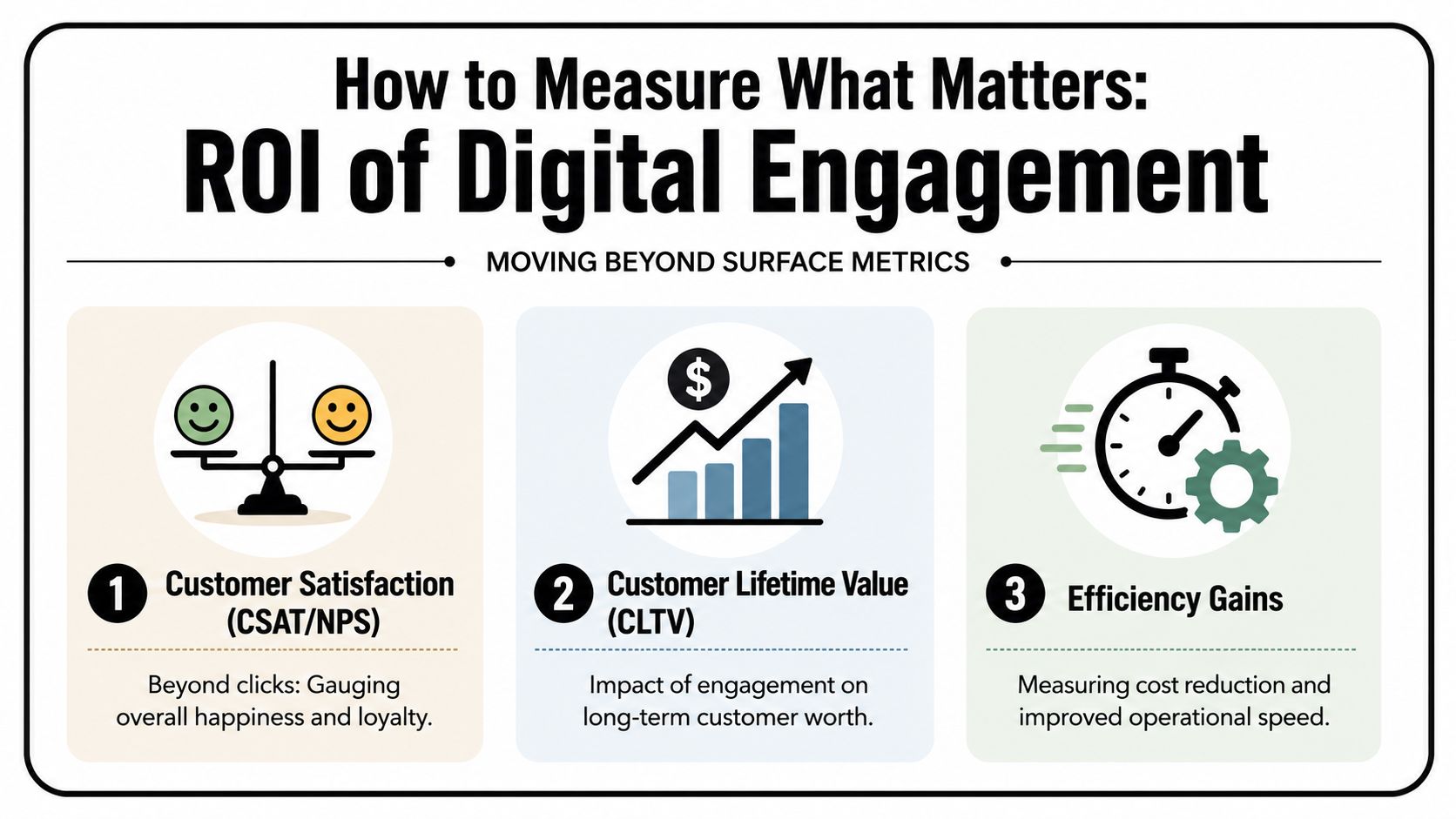
Useful measurement goes beyond opens and clicks. As outlined in MHC Automation's discussion of digital customer engagement metrics, expert measurement should tie to behavioral, attitudinal, and business-impact metrics such as session duration, feature adoption, conversion rate, CSAT, NPS, retention, and churn reduction.
That framework is practical because it forces you to ask better questions than “Did customers interact with the message?”
Three buckets that actually help operators
I prefer to group metrics this way:
Behavioral metrics
These show what customers did.
- Feature adoption: Did people use self-service, chat, or automated scheduling?
- Session behavior: Did they engage long enough to complete a useful action?
- Channel progression: Did a website visitor move from inquiry to call to booking appointment?
Behavioral metrics help you spot friction. If people start the process but rarely finish it, the issue may be routing, wording, or handoff design.
Attitudinal metrics
These tell you how customers felt about the interaction.
A clinic, law office, or service business doesn't need a complicated research department to learn from this. CSAT and NPS can reveal whether automation is helping or irritating. If satisfaction drops after introducing an AI voice agent, the script or escalation logic may be wrong.
Business-impact metrics
At this point, ROI becomes credible.
- Conversion rate: Are more inquiries becoming consultations, visits, or sales conversations?
- Retention and churn: Are customers sticking around longer once communication improves?
- Appointment booking rates: Is the system turning inquiries into scheduled time on the calendar?
For practical planning, a simple ROI calculator for customer engagement investments can help frame the business case before you change systems.
Better reporting won't rescue a weak process. But weak reporting will hide a good process, and that's how strong engagement programs get undervalued.
A simple measurement discipline
You don't need dozens of KPIs. You need a chain of evidence.
Track the incoming interaction. Track the handoff. Track the completed action. Then connect it to the result that matters, whether that's a resolved issue, a retained customer, or a booked appointment. If that chain is visible, optimization becomes straightforward. If it isn't, you're managing by anecdotes.
Digital Engagement in Action Industry Examples
The mechanics become clearer when you see them in context.
Healthcare and dental
A patient calls after hours to ask about availability. Instead of voicemail, an AI voice agent answers, handles common intake questions, and offers to book an appointment. The front desk comes in the next morning with a confirmed visit already on the schedule and a record of what the patient needed.
That setup also helps when staff are busy in-office. Calls still get answered, routine questions don't pile up, and patients don't need to wait for basic next steps.
Legal and professional services
A potential client calls a law office in the evening after finally getting time to deal with a pressing issue. The system captures the matter type, routes urgent cases correctly, and books an initial consultation when appropriate. If a live handoff is needed the next day, the team already has context instead of starting intake from scratch.
For professional services, this matters because first response often shapes trust. Slow intake feels like indifference.
Growing SMBs and service teams
A small retail or service business often has the same problem in a different wrapper. Calls, chats, emails, and text messages come in all day, but the team is too small to babysit every inbox. A unified queue lets them work from one place, respond in order, and automate routine updates like confirmations and follow-ups.
The businesses that handle growth well aren't always the ones with the biggest teams. They're the ones that stop forcing staff to do repetitive communication work by hand.
When that system includes booking appointment workflows, the business stops losing demand in the cracks between channels.
Conclusion Your Next Step Toward Growth
Digital customer engagement isn't about collecting channels. It's about building one connected experience that helps customers get answers, move forward, and book an appointment without friction. The businesses that get this right don't just sound more modern. They respond faster, waste less staff time, and measure what the system contributes to revenue and retention.
Start with one honest question: where does your current communication process break down? Usually, that answer points directly to the first upgrade worth making.
If your business is replacing a legacy phone system or trying to unify calls, AI voice workflows, and appointment booking into one measurable setup, Cloud Vision Technologies LLC is one provider to evaluate. Its platform combines Hosted VoIP, an AI Voice Agent, and cloud contact center software, which fits the kind of integrated digital customer engagement model covered here.