If you're calling customers to confirm service windows, remind them about a payment, or book an appointment, and your calls still go unanswered, your phone system may be part of the problem. Many businesses assume call avoidance is purely a sales issue or a customer service issue. Often, it's an identity issue.
A customer sees a strange number, no business name, or a generic label on their screen and lets the call ring out. That missed call then turns into a missed confirmation, a delayed quote, a no-show, or an appointment that never gets booked. In a cloud communications environment, caller line identification service sits right in the middle of that chain.
The old view of caller ID is too narrow. Today, what appears on the recipient's screen can include the number, a business name, verification signals, and sometimes carrier or app-level warnings. If you run a healthcare practice, dental office, law firm, real estate team, field service company, or contact center, that trust layer affects whether someone picks up long before your agent says hello.
Why Your Customers Are Not Answering Your Calls
A dental office calls to confirm tomorrow's cleaning appointment. A property manager calls back a tenant about a maintenance slot. A med spa reaches out because a cancellation opened up and a customer could book an appointment earlier than expected. In all three cases, the outcome often depends on what shows up on the phone before the call is answered.
If the call displays as an unfamiliar number, "Unknown," or something that doesn't match the business the customer knows, people ignore it. They assume it's spam, a robocall, or a number they can deal with later. By the time your team leaves a voicemail, sends a text, and tries again, the simple task has already become operational drag.
That drag adds up in ways owners feel immediately:
- Front desk overload: Staff spend time redialing people who would have answered the first time if the call looked legitimate.
- Booking friction: Customers who were ready to book an appointment don't engage because they don't trust the caller.
- Broken handoffs: Sales, service, and support teams call from different numbers, so the business feels disjointed.
- Customer frustration: People say, "I saw the missed call but didn't know it was you."
A business call isn't just a conversation. It's a trust test that happens on the lock screen.
Caller line identification service proves its value. At the practical level, it helps move your business from "random incoming call" to "recognizable contact." That changes the odds of getting through for appointment reminders, intake calls, estimate follow-ups, and outbound booking workflows.
It also matters when you add automation. If you're using an AI receptionist for appointment scheduling and call handling, the voice flow can be polished and the routing can be excellent, but none of that helps if customers won't answer the call in the first place.
What Caller Identity Really Means in 2026
Most business owners use the phrase "caller ID" as if it's one setting. It isn't. Modern caller identity works more like a stack of signals, and each layer affects whether your call looks trustworthy.
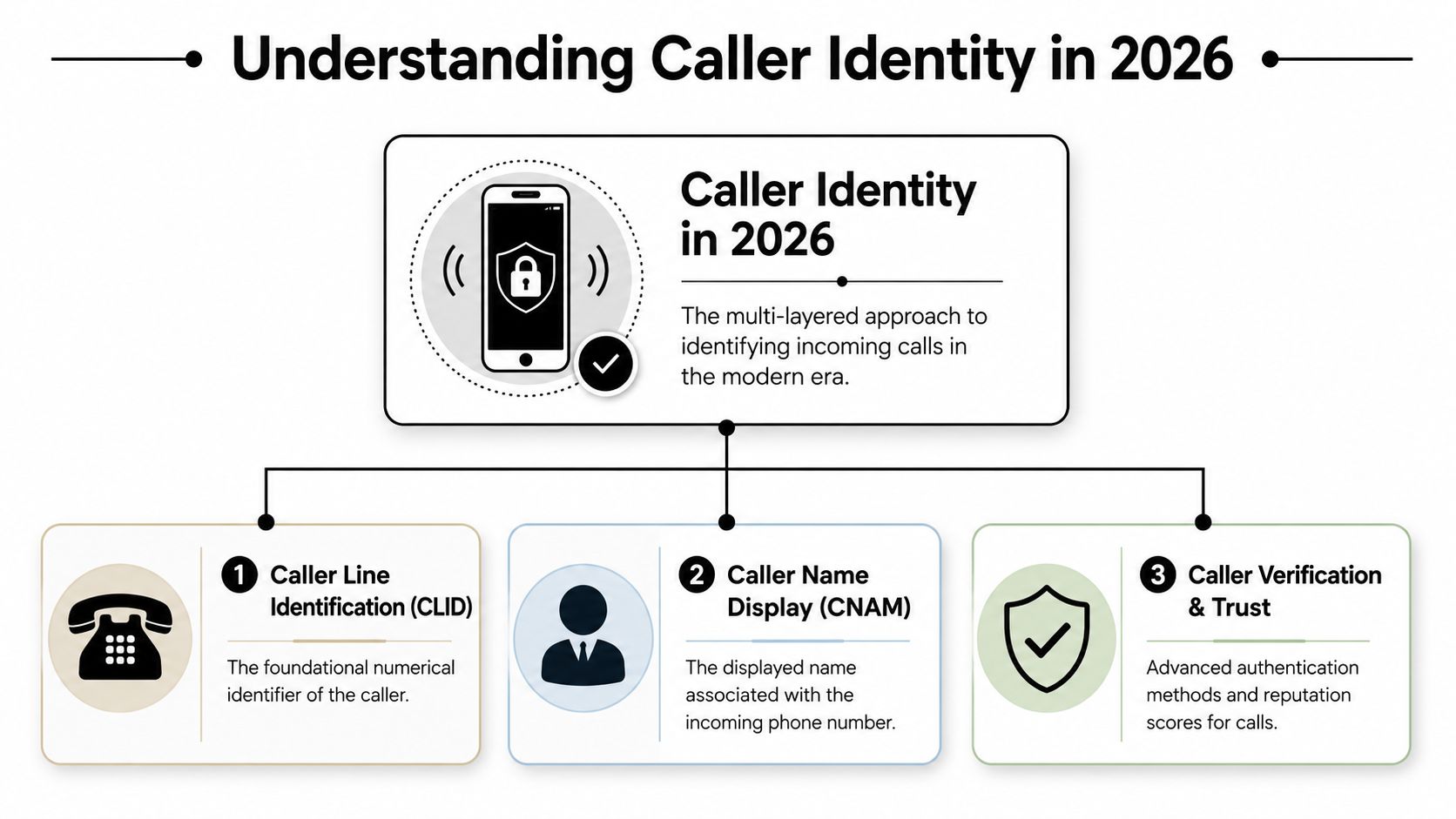
The three layers that shape what your customer sees
The first layer is Caller Line Identification (CLID). This is the outbound number presented with the call. It answers the basic question: what number is calling me?
The second layer is CNAM. That's the displayed caller name that can be associated with the number. It answers a different question: who does this number belong to?
The third layer is verification and trust. In IP calling, STIR/SHAKEN attaches and verifies digital certificates as calls move across networks, which helps carriers validate whether the presented identity is legitimate, as outlined by the OnSIP explanation of caller ID, CNAM, authentication, and spam labeling.
Those layers don't always behave as one clean package. A business can send the correct number and still get weak results if the name doesn't display properly or if downstream carriers apply their own trust logic.
Why the old "just show my number" approach fails
A lot of teams stop at the number. They provision a direct line or a main office line and assume the job is done. That worked better in an era when caller ID mostly meant number presentation.
It doesn't work as reliably now because the receiving network may independently decide whether to show a name, suppress details, or apply a spam-related label. That's the gap many businesses miss. They think they've configured caller ID correctly, but customers still see something incomplete or unconvincing.
A simple comparison helps:
| Layer | What it does | Common business mistake |
|---|---|---|
| CLID | Presents the calling number | Using too many inconsistent outbound numbers |
| CNAM | Displays a caller name when available | Assuming the phone system name automatically updates public display |
| Verification | Supports trust in the presented identity | Ignoring authentication and carrier reputation |
Practical rule: Treat caller identity as a managed business asset, not a phone system checkbox.
If your team places outbound calls to confirm service, collect intake details, or book an appointment, the customer doesn't separate these layers. They only see one outcome. Either the call looks trustworthy, or it doesn't.
How CLID Technology Works Behind the Scenes
Think of a business call like a package moving through a delivery network. Your phone system creates the shipment label. The carrier routes it. The destination side may check a directory before deciding what name to show the recipient.
That analogy is close to how caller line identification service works in practice.
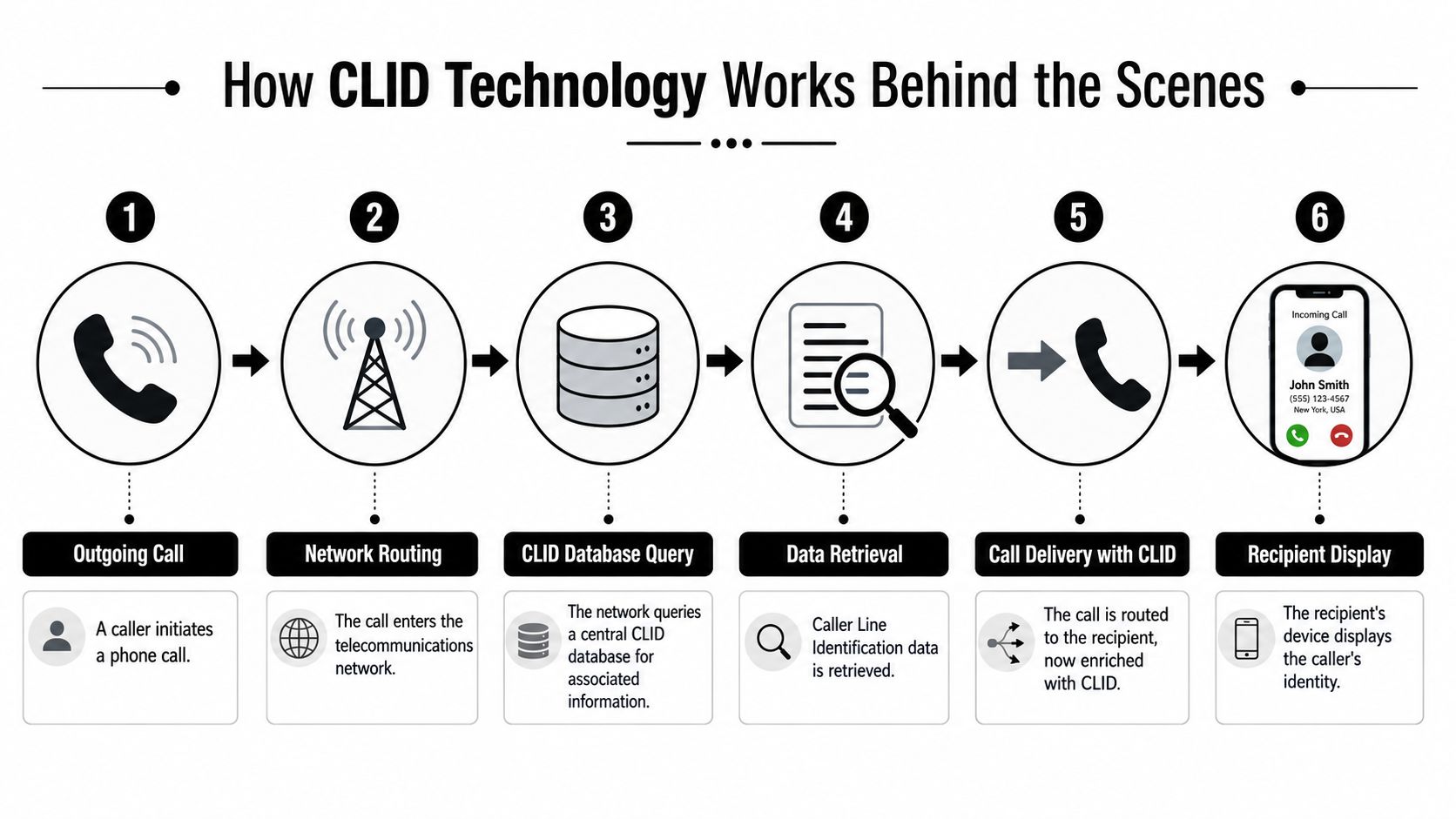
What happens when your business places a call
Your cloud phone system or VoIP platform originates the call and sends signaling data that includes the outbound number. That number is the CLID portion. It's the foundational identifier attached to the call.
The call then travels through carrier infrastructure until it reaches the recipient's side. At that point, the receiving network may perform a database lookup to determine what caller name to display. In many networks, that name isn't merely stored on the handset. The carrier mediates it.
This is why two people can receive the same call from your business and see slightly different information. Device behavior, carrier databases, and app logic can all influence the final display.
Where business owners get surprised
The biggest surprise is usually the name field. In the United States, the displayed CNAM name is typically limited to 15 characters, with a common display length of 9 to 12 characters, while the number is usually shown as a standard 10-digit identifier, according to Skyetel's overview of caller ID evolution and CNAM behavior.
That creates very practical constraints:
- Long brand names get cut down: If your legal business name is lengthy, customers may only see part of it.
- Department labels may not fit: "Northside Dental Scheduling" won't display cleanly in many cases.
- Abbreviations matter: The short form you choose may be the only name a customer sees before deciding whether to answer.
A useful way to think about it is this. Your public caller identity needs a version built for the phone screen, not just a version built for invoices and signage.
Why display can vary even when your setup is correct
Even with proper configuration, display can be inconsistent for reasons outside your direct control. The receiving carrier may have different lookup behavior. A mobile app may prioritize its own spam or identity data. One phone may show a name while another shows only the number.
That doesn't mean the system is broken. It means caller identity is partly under your control and partly shaped downstream.
When a business says, "Our caller ID is set up, but some customers still don't see us correctly," that's often a network behavior issue, not an agent behavior issue.
For appointment-driven teams, this is why testing matters. Test live calls to different carriers and devices. Don't stop after checking the display on one office mobile phone.
The Business Benefits of a Trusted Caller Identity
Caller identity started as a display feature and grew into a more important business tool over time. Caller line identification was first formalized by the ITU-T in 1993 in Recommendation Q.731.3, while commercial deployment began as early as July 7, 1984, according to the history of Caller ID and CLI standardization. That long evolution matters because businesses now rely on it for much more than showing a number.

Better trust at the moment of contact
Every outbound call asks the customer for a small decision: answer now, ignore, or block mentally and move on. A trusted identity lowers the hesitation.
That matters for routine work. A medical office confirming an appointment, a law office returning a consultation request, or a home services company updating arrival times all depend on quick recognition. If the customer trusts the call, conversations start faster and fewer tasks spill over into voicemail tag.
Smoother workflows for revenue and service teams
Caller identity affects how cleanly your teams operate across the whole funnel. Sales needs consistency. Support needs recognizable callbacks. Billing needs legitimacy. Scheduling needs confidence so customers will stay on the line long enough to book an appointment.
Strong caller identity also supports system automation. If your business uses outbound workflows for reminders, follow-ups, intake, or collections, the interaction works better when the call appears connected to a real organization rather than a mystery number.
A few operational wins show up quickly:
- Sales follow-up becomes less wasteful: Reps spend less time chasing people who screened the call on sight.
- Service coordination improves: Dispatch, field service, and office staff can call from numbers customers recognize.
- Appointment workflows get cleaner: Reminder calls and rebooking calls are more likely to lead to a confirmed or newly booked appointment.
- Analytics become more usable: When teams standardize outbound identity, it's easier to compare departments and campaigns.
For finance-minded owners, it also helps to model the broader telephony picture. A VoIP savings calculator for business phone planning can help frame the cost side while you evaluate call handling, automation, and caller identity together.
Why automation depends on trust
Many companies want an AI voice workflow to handle repetitive outbound tasks such as confirmations, reminders, and appointment booking. That's sensible. But automation doesn't rescue poor trust signals. It amplifies them.
If the call looks questionable, customers won't answer long enough to hear the reason. If the identity looks credible, an automated system can complete simple jobs well, including confirming details or helping someone book an appointment without staff intervention.
A short explainer is helpful here:
The point isn't that caller identity solves every calling problem. It's that poor identity erodes good operations.
Navigating Caller ID Regulations and Security
Security and compliance shape caller identity just as much as branding does. If your business only thinks about what name to display, you're missing the operational risk side.
What STIR SHAKEN does in plain English
STIR/SHAKEN works like a digital trust check for IP calls. The originating provider attaches a digital certificate that helps downstream carriers verify the asserted caller identity as the call travels across IP networks. That helps reduce spoofing risk because receiving carriers can validate whether the presented CLI is legitimate before display, as described in the UK ICO guidance on line identification and caller authentication.
For a business owner, the practical takeaway is simple. Verified identity supports trust. Unclear identity invites scrutiny.
That doesn't mean every verified call will be welcomed, and it doesn't mean every unverified call is bad. It means carriers now have stronger tools to assess whether your call presentation looks credible.
Privacy rules still matter
In the UK, the ICO requires providers to allow callers to withhold their number and allow recipients to block anonymous calls. That has two direct implications for businesses.
First, masking identity casually is a bad habit unless there's a legitimate reason and a compliant setup behind it. Second, if your operation depends on outbound calling for reminders, intake, and appointment booking, you need a policy that balances privacy with answerability.
Security and privacy don't compete. Poorly managed caller identity creates problems on both sides.
What works and what doesn't
What works:
- Using numbers your business is authorized to present
- Keeping outbound identity consistent by department
- Reviewing how your provider handles authentication
- Testing real customer-facing display before launching campaigns
What doesn't:
- Rotating random numbers to "get around" call screening
- Blocking your identity for routine business calls
- Assuming compliance is only a carrier problem
- Treating spam labeling as unrelated to trust practices
If your team handles healthcare scheduling, financial conversations, or legal intake, this matters even more. Customers are being asked to discuss sensitive details. They won't do that if the incoming call feels questionable.
Implementing CLID in Your Cloud Phone System
The hardest part of caller identity in a cloud environment isn't turning it on. It's keeping it coherent across users, departments, locations, and workflows.
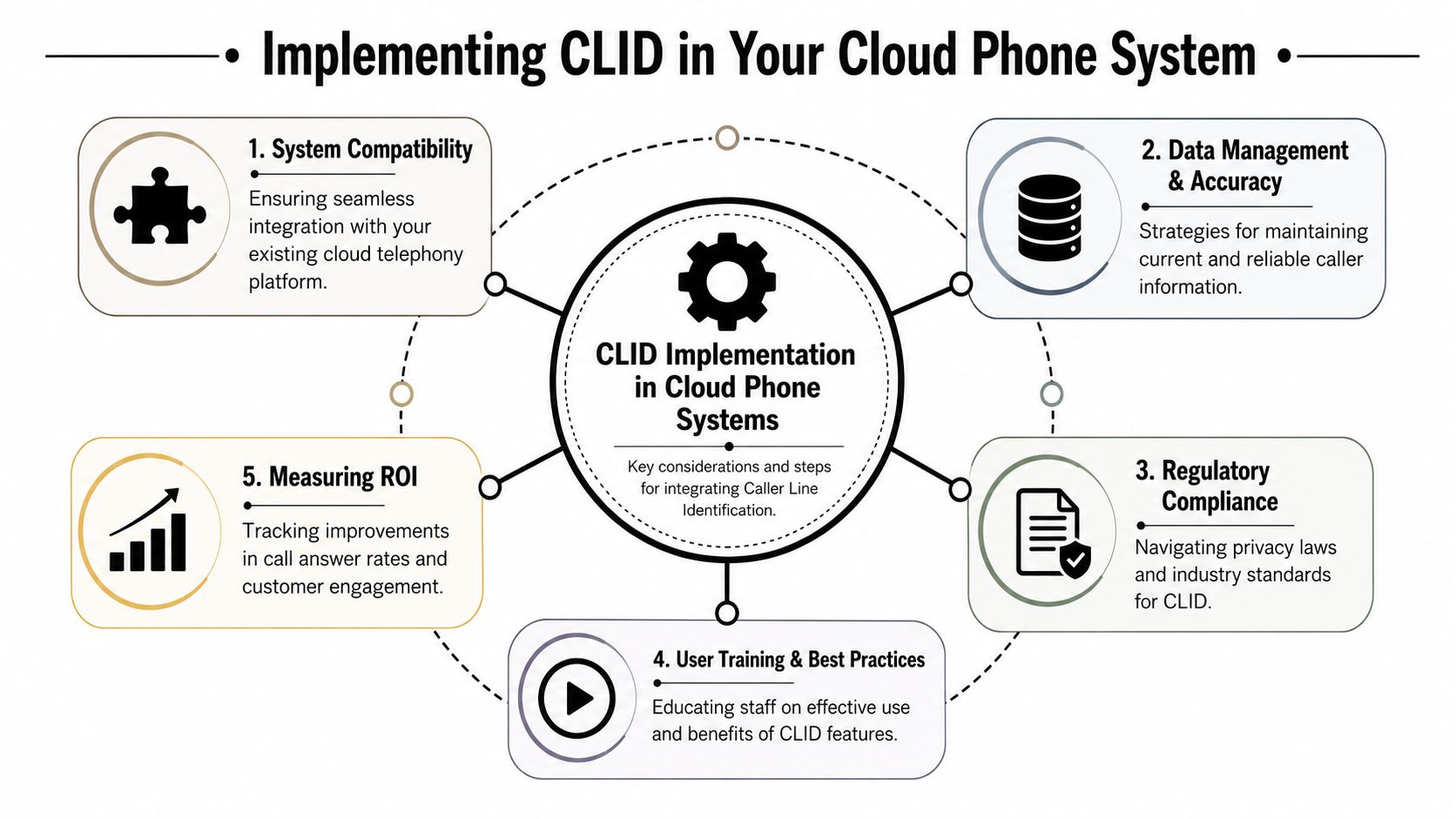
Start with an identity map
Before changing settings in your PBX, contact center, or VoIP admin portal, list the outbound scenarios that matter most. Most SMBs have more than they realize.
A typical map includes:
- Main office calls
- Sales outreach
- Support callbacks
- Billing
- Scheduling and appointment booking
- After-hours or automated outbound notifications
For businesses on modern cloud systems, one of the biggest challenges is keeping caller identity consistent across teams and locations. Carriers and apps may show names, pictures, or spam warnings, which means enterprises need more than a static main number strategy, especially for appointment-heavy operations and high-volume outreach, as noted in the Babelforce explanation of caller line identification in cloud environments.
Build rules by function, not by convenience
Many companies let each user present whatever number is easiest. That creates confusion fast. A better approach is to assign outbound identity by business function.
For example:
| Team or workflow | Better outbound identity choice | Why it helps |
|---|---|---|
| Front desk | Main published number or scheduling line | Customers recognize it for booking and appointment follow-up |
| Sales | Dedicated local or team number used consistently | Builds repeat recognition across touchpoints |
| Support | Support queue callback number | Makes return calls easier for customers |
| Automated reminders | A clearly owned business number | Improves trust for confirmations and appointment reminders |
This is where CRM and workflow integration matter. If a customer belongs to a specific branch, region, or department, your system should present the most relevant identity available instead of a generic corporate number.
Train the operation, not just the system
Implementation fails when the platform is configured well but staff behavior is loose. Reps bypass approved numbers. Managers launch outreach from temporary lines. Branches improvise naming conventions.
Use a short governance checklist:
- Approve your display names: Decide the short version that fits phone display constraints.
- Limit outbound number choices: Give users the right options, not endless options.
- Align CRM and telephony: Make sure appointment and callback workflows use the intended number.
- Retest after changes: Carrier-side display can lag or vary after updates.
One option in this category is a cloud contact center platform for managed outbound and inbound workflows. Cloud Vision Technologies LLC also provides cloud telephony, AI voice agent, and contact center tools that can support caller identity management as part of broader business calling operations.
The businesses that handle caller identity well don't treat it as a telecom detail. They treat it as part of customer experience design.
Troubleshooting Common Caller ID Issues
When caller line identification service isn't behaving the way you expect, the fix is usually operational, not mysterious. Start with the display problem itself and work backward.
Why is the wrong company name showing when we call
Most often, your business assumes the phone system label equals the public caller name. It often doesn't. The receiving side may rely on a carrier lookup or other downstream logic, so the displayed name can lag, truncate, or differ from your internal setup.
Check whether your chosen short business name fits common phone display constraints and whether all outbound numbers are tied to the identity you intend customers to see.
Why do our calls show as unknown or private
This usually points to one of three issues. The outbound number isn't being presented correctly, the call is being sent with privacy settings that suppress identity, or the receiving side isn't displaying the available information.
If you rely on outbound calling to confirm appointments or help customers book an appointment, test from the exact user, queue, or automation flow involved. Don't test only from the main office phone and assume everything else matches.
Can we use our business name on employee mobile calls
Sometimes, but not automatically. Mobile-originated calls often behave differently from calls sent through a managed business voice platform. If employees are calling customers directly from personal devices, expect inconsistency.
A better approach is to route business outbound calls through your cloud phone system or business calling app so the presented identity is governed centrally.
Why are some calls answered and others ignored even from the same company
Because the number alone isn't the whole trust signal. Carrier behavior, name display, verification status, and downstream labeling all affect how the call is perceived.
If one department uses a recognizable scheduling number and another rotates through assorted lines, the customer experience won't be consistent. That shows up fast in appointment reminders, callback workflows, and outbound booking.
How do we reduce the risk of spam labeling
You can't solve that with one switch. What helps is disciplined outbound behavior.
- Use stable numbers: Don't bounce between too many presentation numbers.
- Keep identity aligned: Number, business name, and department purpose should make sense together.
- Work with your provider: Ask how authentication and outbound identity are managed.
- Review calling patterns: Sudden changes in behavior can create trust problems even when configuration is technically correct.
If you're not sure where the breakdown is, run a simple audit. Call multiple carriers, review each department's outbound number plan, inspect scheduling and appointment-booking workflows, and check whether your automation uses the same identity rules as your live staff.
If your business depends on answered calls, customer trust, and reliable appointment booking, Cloud Vision Technologies LLC can help you evaluate how your cloud phone system, caller identity, AI voice workflows, and contact center setup fit together. The practical goal is simple: make sure customers recognize your calls, trust them enough to answer, and can book an appointment without friction.