A sales rep tries to call a prospect overseas. The number looks right, but the call won't connect. Later that day, the same business exports customer records and finds three different versions of the same country in the CRM. One entry uses a phone prefix, another uses a two-letter code, and a third spells the country name out in full.
That's usually when people ask, what is a country code, and they expect a simple answer.
The problem is that there isn't just one kind of country code. In business operations, the term can mean a dialing prefix for a call, a standardized identifier for customer data, or even a web location signal like a country domain. If your team mixes them up, you get failed calls, broken automations, messy reporting, and friction in tasks that should be routine, including booking appointment requests from international customers.
More Than Just a Number on a Dial Pad
For many businesses, country codes only become visible when something breaks.
A call center agent enters an international lead into the phone system. Marketing imports contacts from a tradeshow list. A receptionist tries to confirm a consultation and can't tell whether the stored value belongs in a phone field or a country field. None of these problems feel theoretical when they interrupt sales, support, or booking appointment workflows.
Why the term causes so much confusion
“Country code” sounds singular, but businesses use several code systems for different jobs. Telephone systems need one format. Statistical and CRM systems often need another. Teams then copy values between tools as if they were interchangeable, and that's where small errors turn into operational ones.
Practical rule: If a code is being used to route a call, identify a country in a database, and label a website market, it's probably the wrong code in at least two of those places.
This isn't a new problem. Country codes have supported cross-border data processing for decades. The UN statistical framework helps make international datasets comparable over time, and a U.S. Census Bureau research guide notes country-level statistical data from 1950 onward for 227 countries and regions, which shows why standardized country identifiers matter for long-term analysis and reporting (UN M49 methodology).
Why it matters to daily operations
When codes are inconsistent, the pain shows up in very ordinary places:
- Sales outreach fails: Reps can't reliably dial international numbers from the CRM.
- Routing rules break: Calls don't reach the right regional queue.
- Reporting gets noisy: Customer locations appear under multiple labels.
- Appointment handling slows down: Staff waste time fixing numbers before confirming or booking appointment requests.
If your team is cleaning up any of that right now, a practical next step is to use a structured operations checklist rather than patching one field at a time. This communications planning guide is a useful starting point for organizing that work.
The Three Types of Country Codes You Need to Know
When someone asks what is country code, the safest answer is this: it depends on the job you need the code to do.
Business travel offers a useful comparison: Your phone number gets you connected. Your passport identifies you. Your destination address tells people where you're going. Country codes work the same way. One routes calls, one identifies countries in systems, and one signals geography on the web.
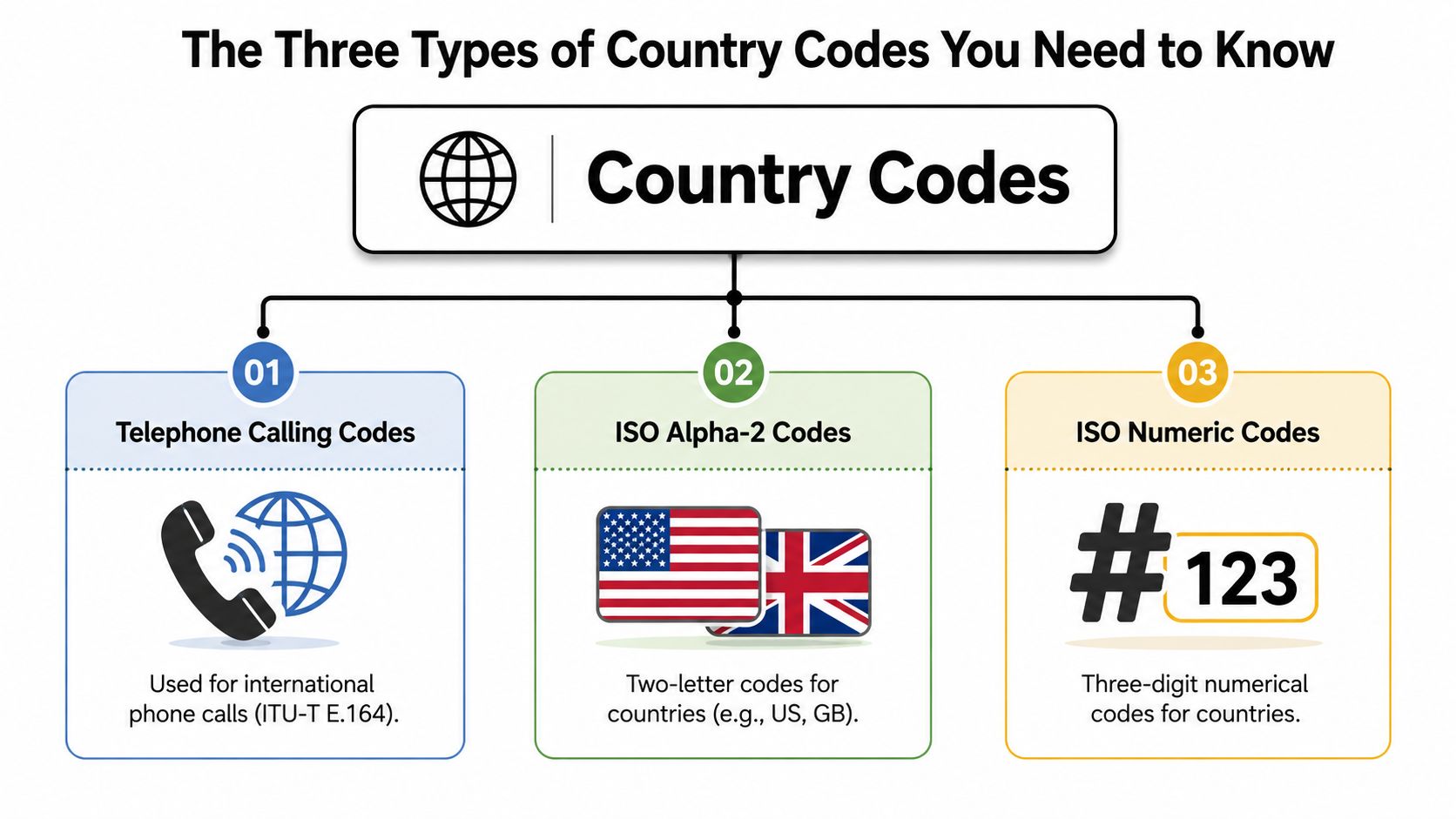
Telephone calling codes
These are the codes used in international dialing. They belong to the global telephone numbering framework and tell the network which national system should receive the call.
If your business uses VoIP, softphones, or cloud calling, this is the code type that directly affects whether a customer call connects.
ISO country codes
For customer records, analytics, shipping systems, and official reporting, the most widely used standard is ISO 3166, which defines alpha-2, alpha-3, and numeric country codes. ISO states that alpha-2 is the general-purpose format, while the numeric format is useful when Latin script should be avoided (ISO 3166 country codes).
Examples matter here. Canada can appear as CAN in ISO alpha-3 and 124 in UN M49. That's normal. Different systems use different standardized representations.
Country code top-level domains
You also see country codes in website domains such as national market domains. These help signal geographic targeting online, but they are not telephone codes and shouldn't be pasted into CRM country fields unless that's explicitly how your system is designed.
Country code examples for major economies
| Country | Telephone Code (ITU) | ISO 3166-1 Alpha-2 | ISO 3166-1 Alpha-3 | ccTLD |
|---|---|---|---|---|
| United States | +1 | US | USA | .us |
| United Kingdom | +44 | GB | GBR | .uk |
| Canada | +1 | CA | CAN | .ca |
The business takeaway
A single country can have multiple valid codes at the same time. That's why teams get tripped up.
- Use telephone codes for calls and SMS routing
- Use ISO codes for CRM fields, trade data, and reporting
- Use ccTLDs for web and market localization context
One country. Multiple code systems. Different operational jobs.
Once your team accepts that, it gets much easier to fix forms, normalize records, and support reliable booking appointment flows across regions.
A Deep Dive into Telephone Country Calling Codes
Telephone country calling codes are the version most business owners run into first, because they're tied directly to whether a call goes through.
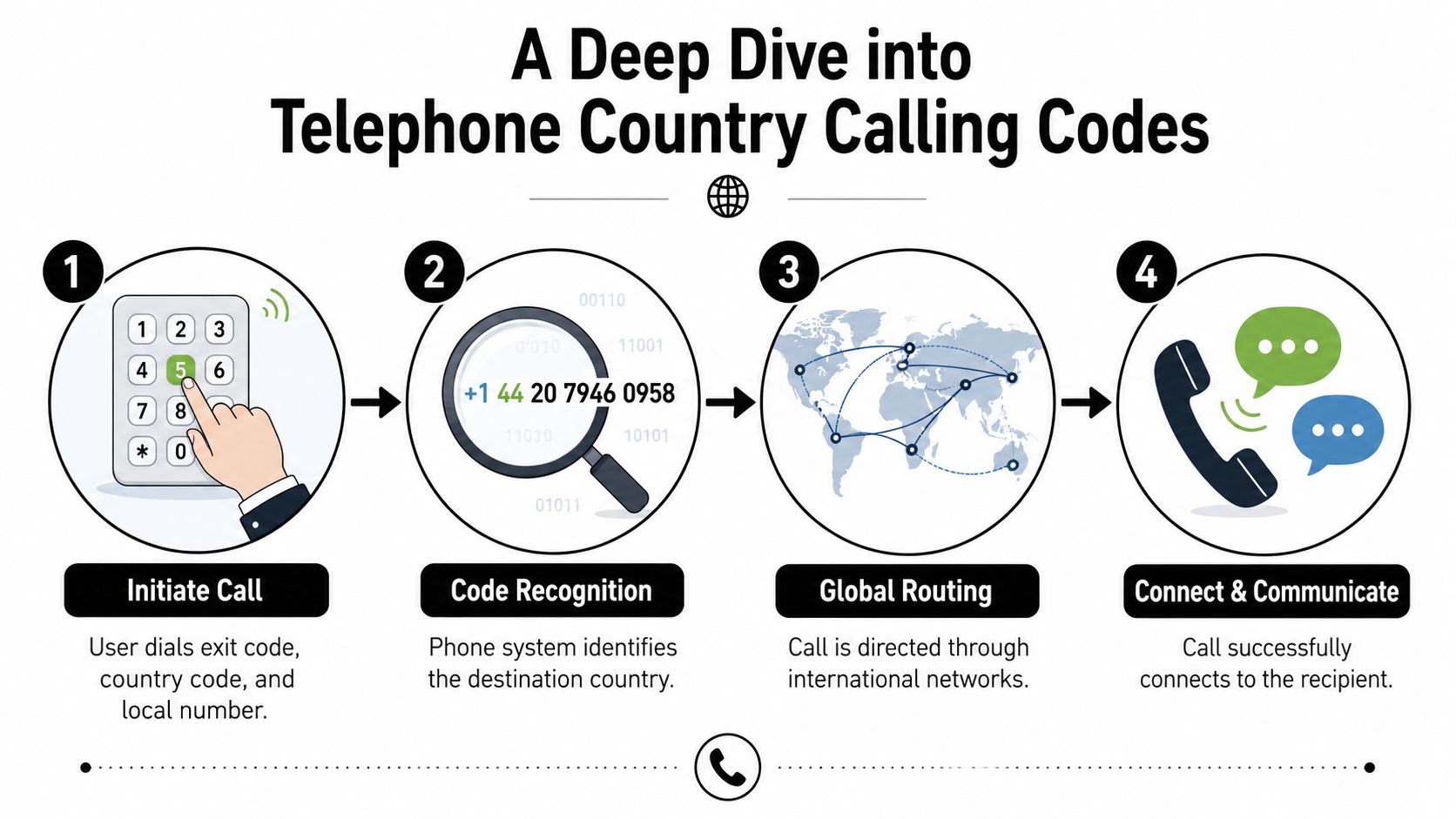
They are part of the ITU-T E.164 numbering plan. In practice, the code is dialed after an international prefix, and it routes the call to the correct national network. That's why international dialing usually follows the pattern exit code + country code + national number. It's also why the leading trunk prefix is typically removed when calls cross borders (country calling code overview).
The format your phone system wants
The cleanest way to think about an international business number is:
- Plus sign
- Country calling code
- National number
That leading + matters because it signals an international format rather than a local one saved in a single-country style. Modern cloud phone systems and VoIP platforms often expect this kind of normalized number because it reduces ambiguity.
The part that confuses most teams
The destination number may contain a local trunk prefix when written for domestic dialing. That's often a leading zero used inside the country.
When the call becomes international, that trunk prefix usually isn't dialed. If your staff copies a local number exactly as printed on a business card and pastes it into a CRM without normalization, the system may treat it incorrectly.
Don't store international business numbers the way people say them out loud. Store them the way networks route them.
Why this matters for VoIP and appointment handling
For a business using cloud calling, international routing isn't just about outbound sales. It affects:
- Inbound call recognition: Systems need a normalized number to match the caller to a record.
- Auto-attendants and routing: Regional rules depend on clean number formatting.
- SMS and reminders: Message delivery works better when numbers follow a standard format.
- Booking appointment workflows: AI assistants and front-desk teams can confirm callbacks and schedule follow-ups without manually repairing numbers first.
If your communications stack handles multiple countries, E.164-style formatting is less of a nice-to-have and more of a housekeeping rule that prevents repeat mistakes.
How to Find and Use Country Codes in Your Business
Knowing what a country code is only helps if your business uses the right one in the right place.
Most companies don't need a giant reference sheet taped to the wall. They need a repeatable method that keeps phone numbers, CRM records, and routing rules aligned. That matters most when your team is making international calls, sending reminders, or booking appointment requests for customers in different regions.
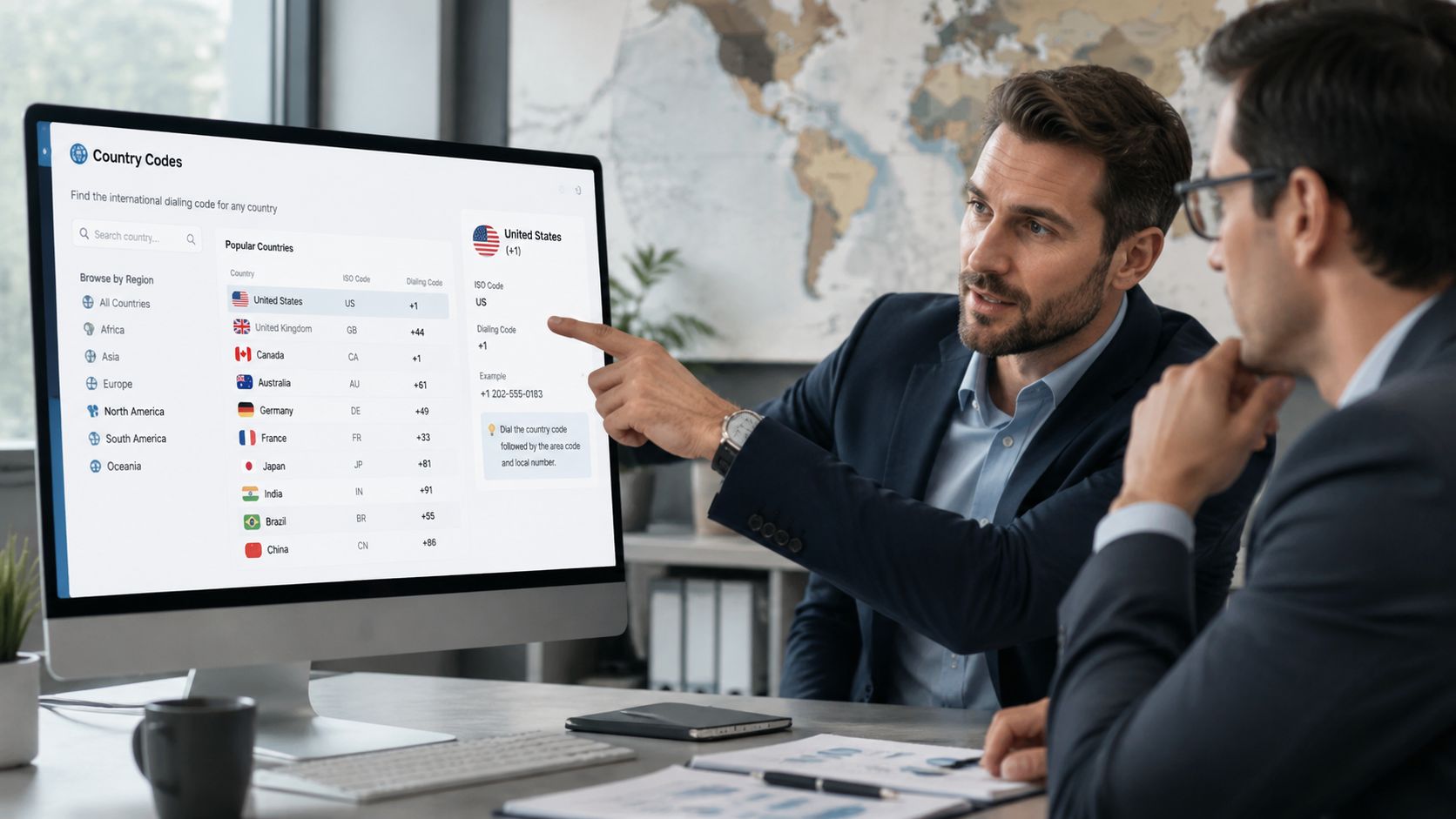
Start with one source of truth
Pick a standard for each job and document it internally.
For example, many teams do well with this division of labor:
- Phone numbers: store in international format for calling and messaging
- Country fields: use ISO codes for CRM, analytics, and exports
- Website forms: separate phone input from country selection
That prevents the classic mistake of putting a dialing prefix into a country field or vice versa.
Clean your CRM first
If your contact records are inconsistent, every other workflow becomes fragile. Before changing your phone system, normalize the data you already have.
A simple process works well:
Audit the phone field
Look for mixed formats, local-only numbers, and text labels pasted into number fields.Separate country and phone data
Don't rely on one free-text field to hold both.Standardize storage rules
Decide how numbers should be saved, then apply the same rule to imports, forms, and manual entry.Test real workflows
Click-to-dial, SMS reminders, and booking appointment confirmations should all work from the same stored number.
Operational insight: Data cleanup is usually faster than debugging the same dialing problem every week.
Configure your VoIP system around real use cases
Once the data is clean, your phone platform can do its job.
That usually means setting outbound dialing rules, matching inbound calls to existing contacts, and building call flows by region or team. If a customer from one market should reach one queue and another region should reach a different team, country-aware routing becomes part of your business logic, not just your telecom setup.
A planning tool can help estimate whether a move to cloud calling is worth it before you start reworking those workflows. This VoIP savings calculator can help frame that decision.
For a visual walkthrough of business phone setup and related workflows, this video gives helpful context:
Fix your forms before the next lead arrives
Website forms are where bad data often begins.
Use form design that guides users instead of forcing them to guess. A country dropdown plus a phone field usually works better than a single open text box. Auto-formatting also helps, but only if it's tied to a clear country selection and doesn't overwrite valid international numbers.
For businesses with inbound scheduling, this is especially important. If a prospect submits the wrong format, your team may miss the callback window or fail to complete the booking appointment process cleanly.
Common Mistakes When Handling Country Codes
Most country-code problems are not advanced telecom failures. They're category mistakes. A team uses the right value in the wrong place, then spends time chasing the symptom instead of the cause.
Mixing code types
Symptom: The CRM has values like “GBR” where the dialer expects a phone prefix.
Cause: Staff assume all country codes mean the same thing.
Solution: Label fields by purpose, not by shorthand. “Country ISO code” and “Phone country code” are better labels than “country code” by itself.
Keeping or dropping the leading zero at the wrong time
Symptom: International calls fail or save incorrectly after import.
Cause: Local formatting rules were copied into an international workflow.
Solution: Normalize numbers for cross-border use before they enter the phone system. Domestic display and international storage are not always the same thing.
Assuming countries and territories map cleanly
Many basic explainers fail to capture the full picture. Country-code lists include territories and special entities, and telecom assignments don't always line up neatly with political expectations. Telecom reference material also notes that +886 is used for Taiwan despite geopolitical complexity, which is a good reminder that “country code” is not always one-to-one with sovereignty (country and calling code reference).
Ignoring edge cases in routing and validation
Territories and special entities can create hidden errors in forms, CRM validation, and call routing.
- Territory handling: A dropdown may treat a territory as part of one country while telecom routing treats it differently.
- Validation rules: A phone formatter may reject a valid number because the region logic is outdated.
- Reporting logic: Dashboards may group records one way while your dialer routes them another.
Edge cases aren't edge cases if you serve customers across borders every day.
The fix is practical. Review your phone validation, country picklists, and routing rules together, not as separate admin tasks. If one system updates and the others don't, friction returns fast.
Simplifying Global Communications with a Modern Phone System
Most businesses shouldn't have to become experts in numbering plans just to place a call or confirm an appointment.
A modern cloud phone system can reduce the manual work by standardizing number formats, applying routing logic consistently, and keeping international communication rules inside the platform instead of inside an employee's memory. That matters for sales teams, support desks, and front-office staff who handle international calls all day.
What the right platform should remove
A good system should take repetitive country-code problems off your team's plate:
- Automatic formatting: It should normalize numbers for calling and messaging.
- Smarter routing: It should send callers to the right queue or region without manual transfers.
- Cleaner customer records: It should help keep phone and country data distinct.
- Reliable automation: It should support AI-assisted call flows, including booking appointment requests across regions.
For businesses handling distributed teams, international leads, or multilingual inbound traffic, a cloud contact center adds another layer of control. Regional routing, call handling, and automation become easier to manage when they live in one place. If you're comparing platforms, these cloud-based contact center solutions show what that setup can look like in practice.
The important point is simple. Understanding country codes helps you avoid mistakes. Using the right communications platform means your team won't have to solve the same mistake over and over.
Cloud Vision Technologies LLC helps businesses modernize calling, routing, and customer conversations with cloud communications built for real operations. If your team is replacing legacy phones, managing international VoIP, or looking for AI support with customer calls and booking appointment workflows, explore Cloud Vision Technologies LLC.