You're probably in one of two situations right now. You're selling into New York from somewhere else, or you already serve New York clients and your current phone setup still makes your business feel distant, fragmented, or hard to reach.
That gap matters more than most owners expect. A prospect may click your ad, visit your site, and still hesitate if the contact path doesn't feel local, familiar, and easy. If the call goes to the wrong person, if appointment booking takes too long, or if follow-up texts come from a disconnected system, you lose momentum fast.
A New York phone number fixes more than caller ID optics. Used well, it becomes part of market entry, trust building, lead routing, and appointment booking.
Why a New York Phone Number is Your Foot in the Door
A non-local number can create friction before your team even says hello. In New York, buyers move quickly and screen aggressively. If your business is trying to win calls, book appointments, or follow up on inbound leads, the first signal you send is often the number itself.
That's why a phone number in New York works as a business asset, not just a telecom line. It tells prospects you serve the market intentionally. It reduces the “Who are these people?” reaction that out-of-state numbers often trigger. For service businesses, that local cue can be the difference between a missed call and a scheduled appointment.
Local familiarity affects trust
A New York area code won't rescue a weak offer. It will, however, remove an avoidable trust barrier.
When a prospect sees a local presence, the business feels easier to reach. That matters in high-consideration categories like healthcare, legal, real estate, home services, and consulting, where people often want to ask a few questions before they commit to booking an appointment.
Practical rule: Don't treat your number as a back-office utility. Treat it as part of your front-end conversion path.
What works and what doesn't
Some companies buy a local number and stop there. That rarely changes much on its own. The number has to support the entire contact experience.
What works
- Using a local number in ads and landing pages so prospects see a consistent New York presence.
- Routing new calls to the right team fast so callers don't bounce around your organization.
- Supporting appointment booking by call and text because some people want to speak first, while others prefer a quick confirmation message.
What doesn't
- Sending all calls to one shared inbox where sales, support, and scheduling requests pile together.
- Publishing a New York number without staffing it properly during the hours your market is active.
- Forcing every inquiry through a form when the buyer is ready to call now.
In practice, the number is your foot in the door only if the experience behind it feels local, responsive, and organized.
The Business Case for a Local NY Presence
New York isn't a side market. It's a concentration of buyers, businesses, appointments, and service demand that can justify a deliberate local communications strategy on its own.
New York City has a Census-reported population of 8,478,072 and a density of 28,217.2 people per square mile, while the broader metropolitan area has a 2024 population of 19,940,274 according to Census Reporter's New York city profile. That density changes how businesses should think about phone access. You're not just “covering a region.” You're operating in one of the country's largest and fastest-moving urban markets.
Why this matters for sales and scheduling
In a dense market, convenience becomes part of credibility. Prospects often choose the company that seems reachable, nearby, and ready to help. A local number supports that perception, especially when your team's goal is to convert inbound interest into a booked appointment.
The payoff usually shows up in practical places:
- More answered calls from local prospects. People are often more willing to pick up when the number looks familiar.
- Cleaner handoff from marketing to sales. Your ad, landing page, and callback number all point to the same local presence.
- Less friction in appointment booking. A local line paired with text reminders and a live pickup path makes scheduling easier.
Where owners make the wrong comparison
Many owners compare a local New York number to a generic toll-free line and ask which one is “better.” That's usually the wrong question. The better question is which one fits the job.
| Use case | Better fit |
|---|---|
| Entering the New York market | Local New York number |
| Building neighborhood or borough-level familiarity | Local New York number |
| Running national support for existing customers | Toll-free can work |
| Booking appointments with local intent | Local New York number |
A local number doesn't replace good operations. It gives good operations a stronger first impression.
If your team depends on callbacks, consultations, demos, intake calls, or appointment booking, local presence isn't cosmetic. It supports conversion and operational efficiency at the same time.
Choosing Your New York Area Code
Area code choice carries brand meaning in New York. Some buyers notice it immediately. Others don't care at all. The smart move is to choose based on your service model, audience, and the kind of local presence you want to project.
New York's phone system became layered over time as demand increased. A current listing of New York City numbers includes 212, 347, 646, 718, 917, and 929, reflecting overlapping service areas rather than a simple one-code-per-place model, as shown on the U.S. Census Bureau New York Regional Office contact page.
Here's the overview at a glance:
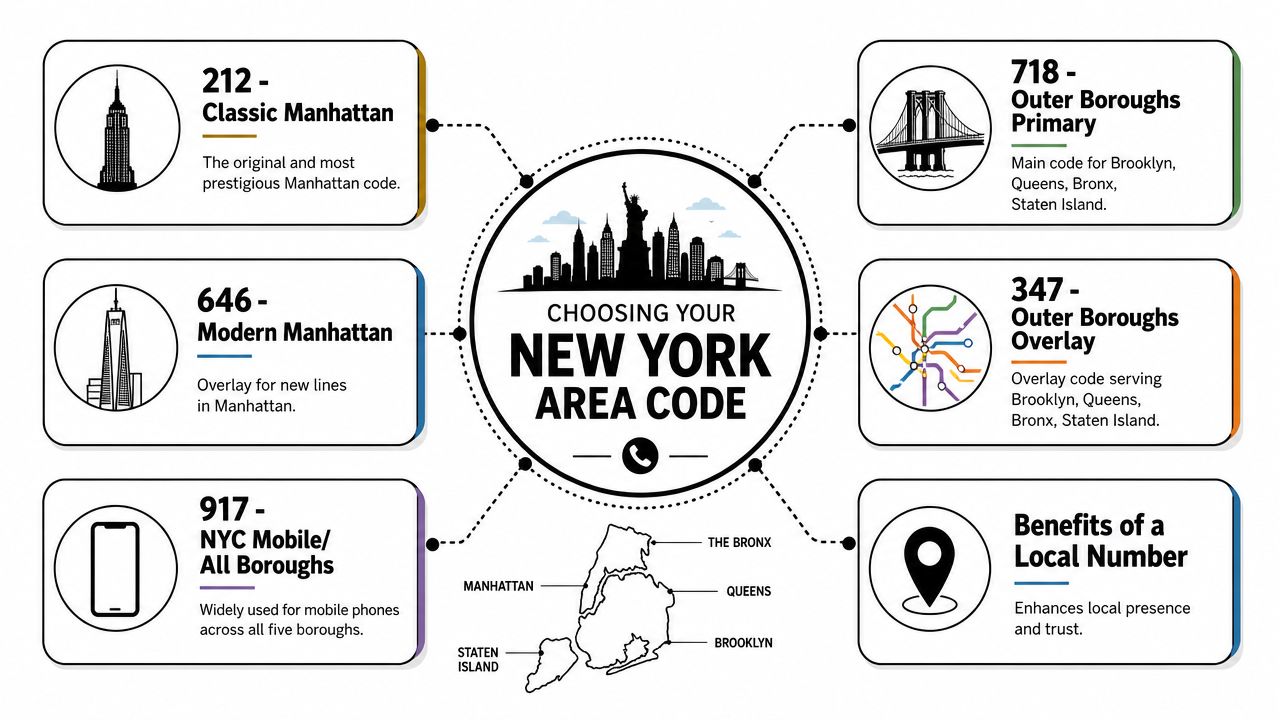
How businesses usually read the codes
212 still carries strong Manhattan recognition. It can signal history, centrality, and an established business identity.
646 is often the practical Manhattan choice when you want that market association without overthinking prestige.
917 is broadly recognized across the city and feels flexible. For many businesses, it's a solid fit when they serve multiple boroughs or don't want to anchor the brand too tightly to one neighborhood image.
718 and 347 are useful when your work is more connected to the outer boroughs or when you want a wider city-serving identity outside the classic Manhattan frame.
A quick visual summary can help if you're weighing brand perception against availability.
A simple decision filter
Use this if you need to choose fast:
- Pick 212 or 646 if Manhattan association helps your positioning.
- Pick 917 if you want broad New York recognition without a narrow borough signal.
- Pick 718 or 347 if your business feels more community-based, residential, or outer-borough focused.
- Don't overpay in time or complexity chasing a code your customers may not value as much as responsiveness.
If your number helps the caller trust you and reach the right person quickly, you chose well.
For most businesses, the winning move isn't the most famous code. It's the code that fits your market story and supports faster appointment booking.
Acquiring Your Number with a Cloud Provider
Getting a New York number no longer has to mean a drawn-out carrier process. Most businesses can handle it through a cloud communications platform, choose the area code they want, assign routing rules, and start using the number without buying desk phone hardware first.
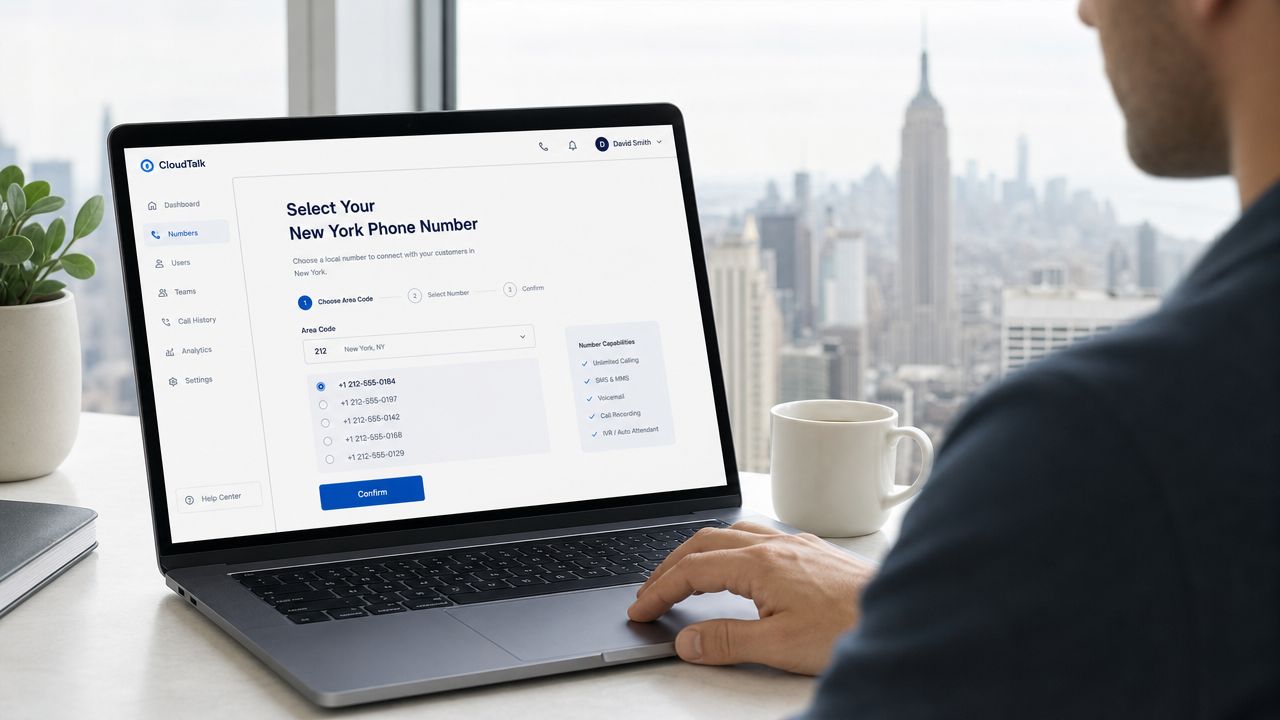
What the setup path usually looks like
The process is straightforward when the provider has a modern admin dashboard.
Choose the provider
Look for number availability, business SMS support, routing controls, and CRM integrations. If you're comparing platforms, review the kinds of cloud communications features listed on the Cloud Vision Technologies product page.Search by New York area code
Start with the code that matches your market position. If inventory is limited for one code, move to the next-best fit instead of treating the search like a trophy hunt.Assign destinations
Decide where calls should go during business hours, after hours, and when no one picks up. This step matters more than the acquisition itself.Enable texting if your workflow needs it
If your business books appointments, texting is usually part of the operating model. Confirmations, reminders, and reschedules are easier when the number can handle both voice and SMS.
Port or start fresh
If you already have a business line, porting may be the cleaner option. It preserves continuity for existing customers while letting you move onto a more flexible phone system.
If you're entering New York for the first time, a fresh local number often makes more sense. It lets you build routing, staff assignment, and appointment booking flows around the market from day one.
A final caution. Don't buy a number just because it's available. Buy one because you know who will answer it, how calls will be routed, and how quickly a caller can book an appointment.
Integrating Your NY Number into Business Workflows
A New York number creates value when it connects to the systems your team already uses. Without integration, calls stay isolated. Staff retype notes, appointment requests get lost, and follow-up becomes inconsistent.
With integration, the number becomes part of one operating flow. The caller reaches your business, your CRM opens the contact record, the conversation gets logged, and the next step happens without manual cleanup.
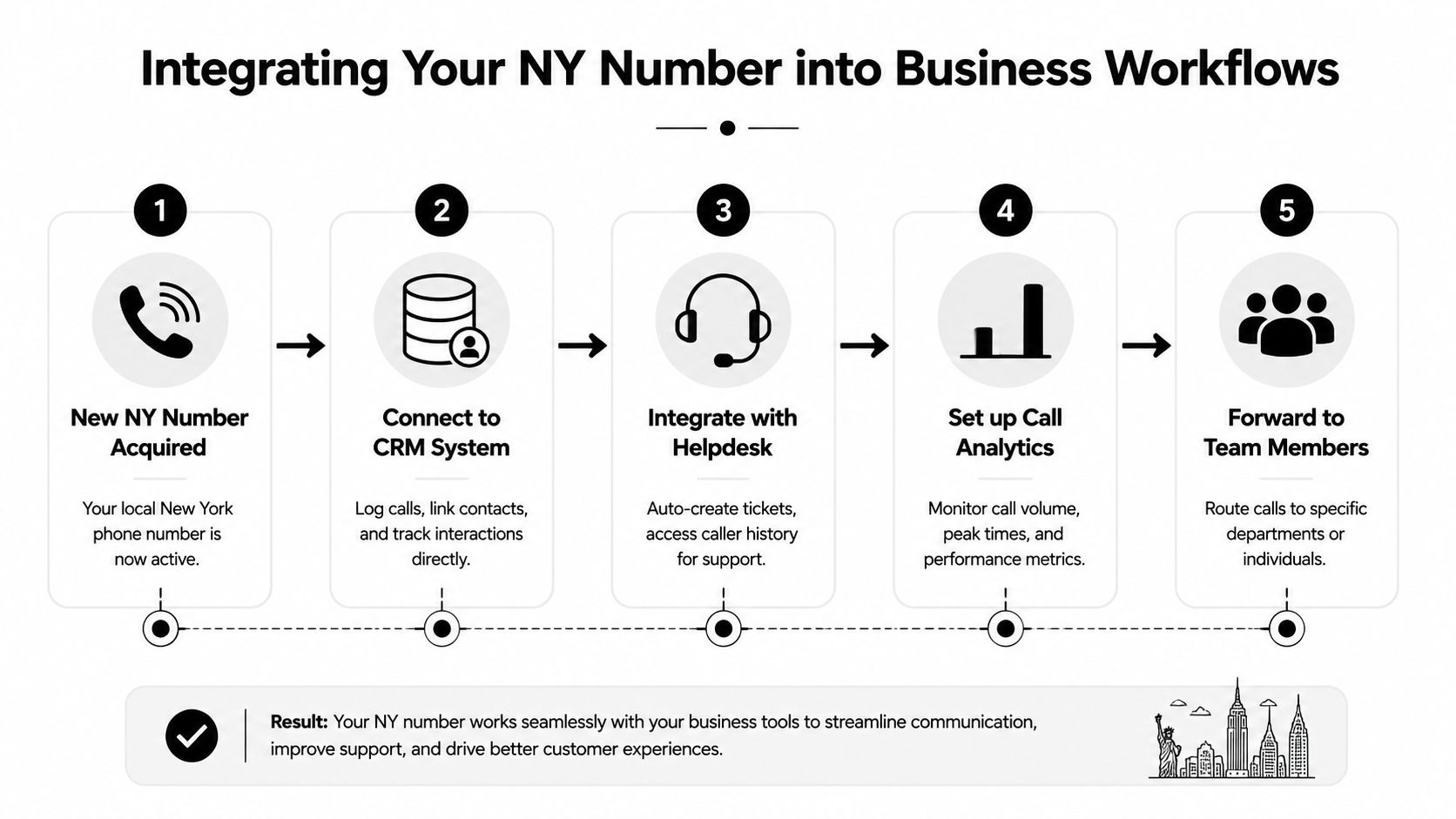
Clean number formatting first
Before you connect the number to a CRM, dialer, or SMS tool, fix your formatting rules. For reliable routing, phone numbers should be stored in E.164 format, which means +1 followed by the 10-digit number, as described in the New York City Center technical specifications PDF.
That standard matters because business systems receive numbers in messy forms. Web forms may include parentheses. Staff may save contacts with spaces or dashes. A dialer may expect machine-readable formatting while your website shows a friendly local version.
What a strong workflow looks like
The simplest useful setup usually includes these pieces:
- CRM connection so inbound and outbound calls tie back to the customer record.
- SMS support for appointment confirmations, reminders, and follow-up messages.
- Call notes or disposition tracking so your team knows whether the caller booked, asked for a callback, or needs a quote.
- Basic automation to move conversations to the next step without relying on memory.
Store the number one way for systems. Display it another way for humans. That's how you keep routing clean without making your website feel robotic.
Appointment booking is where integration pays off
Many businesses realize their biggest operational win here. If your New York number ties into scheduling, your staff can move a caller from inquiry to appointment without switching tools or losing context.
A practical setup might look like this:
| Workflow step | Operational benefit |
|---|---|
| Inbound call hits CRM | Staff sees who's calling |
| Agent books appointment | Scheduling happens during the call |
| SMS confirmation sends | Caller gets immediate reassurance |
| Reminder goes out later | Fewer missed appointments |
| Follow-up is logged | Sales and service stay aligned |
Some businesses also add an AI answering layer for overflow, after-hours coverage, or basic intake. If that's part of your plan, review how an AI receptionist workflow can support appointment booking, FAQs, and handoff to live staff.
Used this way, your New York number stops being a line item. It becomes the intake channel that connects marketing, sales, service, and scheduling.
Optimizing and Testing Your New Communication Hub
Once the number is live and integrated, the next job is control. New York callers won't tolerate a sloppy call path for long. If they hit a dead end, repeat their issue, or wait while your team figures out who owns the conversation, they move on.
That's why optimization matters. Your phone setup should direct callers with the least possible effort, especially when the call is tied to a quote request, intake conversation, or appointment booking.
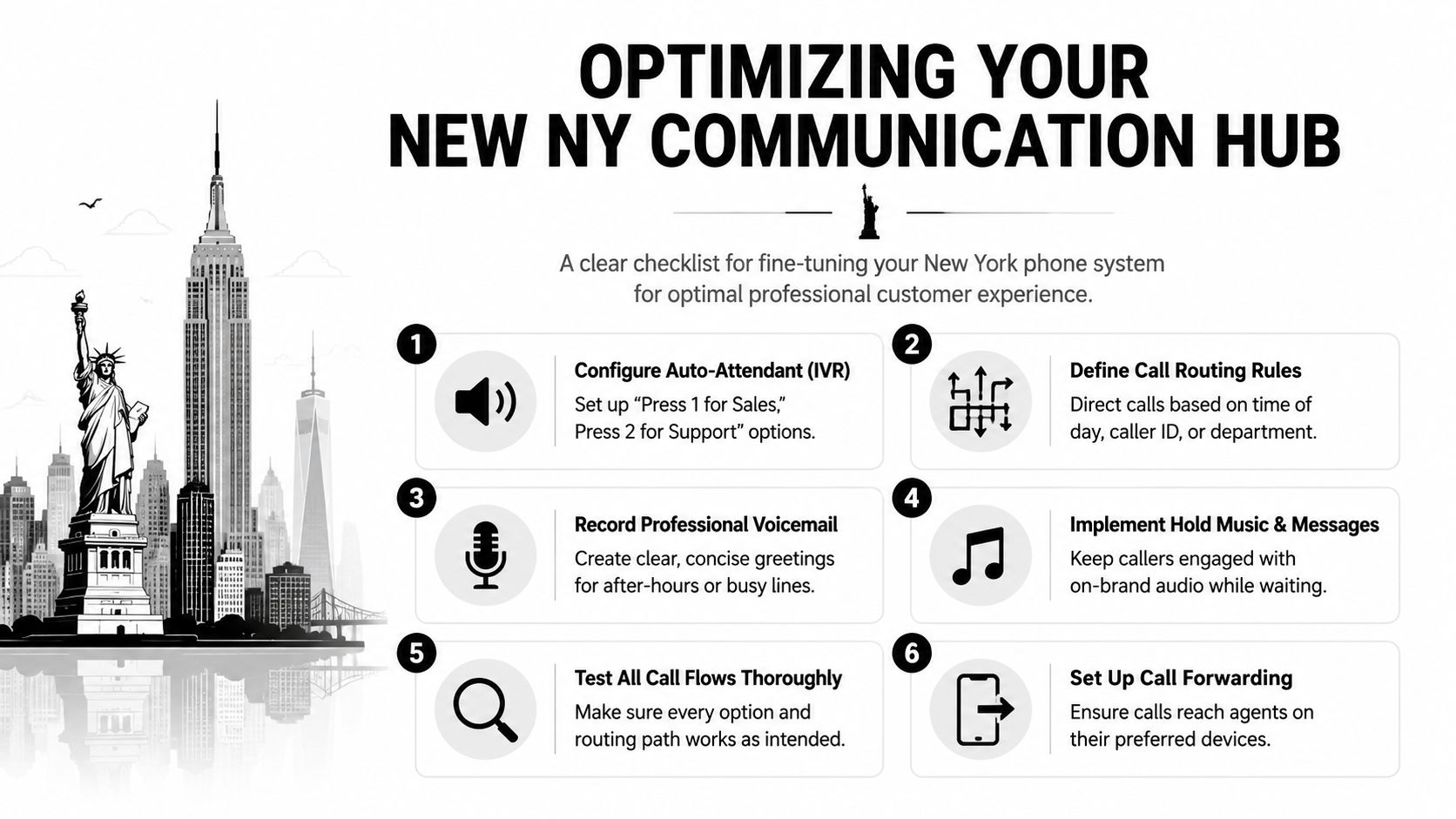
Route by purpose, not by habit
A single main line often isn't enough in complex organizations. The problem shows up when every inquiry lands in the same queue. Administrative questions, new sales inquiries, and urgent service requests don't belong in one bucket.
That's visible even in public-facing service organizations. The New York listing for Services for the Underserved shows an administrative office number of 212-633-6900 and separate service lines for other needs on the New York State Education Department page for Services for the Underserved. The lesson for business owners is simple. Callers need the right department, not just a main number.
What to configure before launch
Use a short checklist and test it from the outside.
- Auto-attendant menu with plain language options like sales, support, billing, or appointments.
- Time-based routing so after-hours calls follow a different path than daytime calls.
- Voicemail handling that sends messages to the correct person, not a general inbox no one owns.
- Fallback call forwarding for missed calls, staff absences, or overflow periods.
- SMS confirmation flow for anyone who books an appointment by phone.
A polished greeting helps. Correct routing helps more.
Test the system like a customer would
Don't stop at one internal test call. Run the whole experience.
- Call the main line from an outside number.
- Try every menu option.
- Book an appointment and confirm the notification goes out.
- Miss the call on purpose and verify voicemail or forwarding behavior.
- Check whether the CRM log reflects what happened.
The best communication hub feels simple to the caller because the business did the messy work beforehand.
Frequently Asked Questions about NY Phone Numbers
Do I need to be physically located in New York to use a New York number
Not usually. Many cloud phone platforms let businesses acquire local numbers for markets they serve. The actual issue isn't your office address. It's whether you can answer calls properly, route them well, and support appointment booking in a way that feels local.
Is 212 always the best choice
No. 212 has strong recognition, but the right area code depends on your brand and service model. Some businesses benefit from Manhattan association. Others are better served by a code that signals broader city coverage or is easier to obtain.
Should I use one number or multiple numbers
It depends on how your business operates. If all inquiries go to one trained team and they can triage well, one main number can work. If you handle different service lines, departments, or appointment types, multiple paths often create a cleaner customer experience.
Can I use the same number for calls and appointment texts
Often, yes. That's one of the most practical setups for service businesses. A single recognizable number for voice and SMS reduces confusion and makes appointment booking feel more effortless for the customer.
What should I ask a provider before I buy
Ask about area code availability, SMS support, routing controls, CRM integration, voicemail handling, and porting. Also ask how they handle access to call records and customer data, and review the provider's published terms such as the Cloud Vision privacy policy.
How quickly should the system be tested after setup
Immediately. Don't wait until leads are already calling. Test inbound calls, outbound caller ID, voicemail, text delivery, and the appointment booking flow before you publish the number in ads, listings, or sales outreach.
If you want a New York number to do more than ring, Cloud Vision Technologies LLC can help you build the full workflow around it, including local presence, routing, CRM connectivity, SMS, and appointment booking so your team can convert calls into real business.